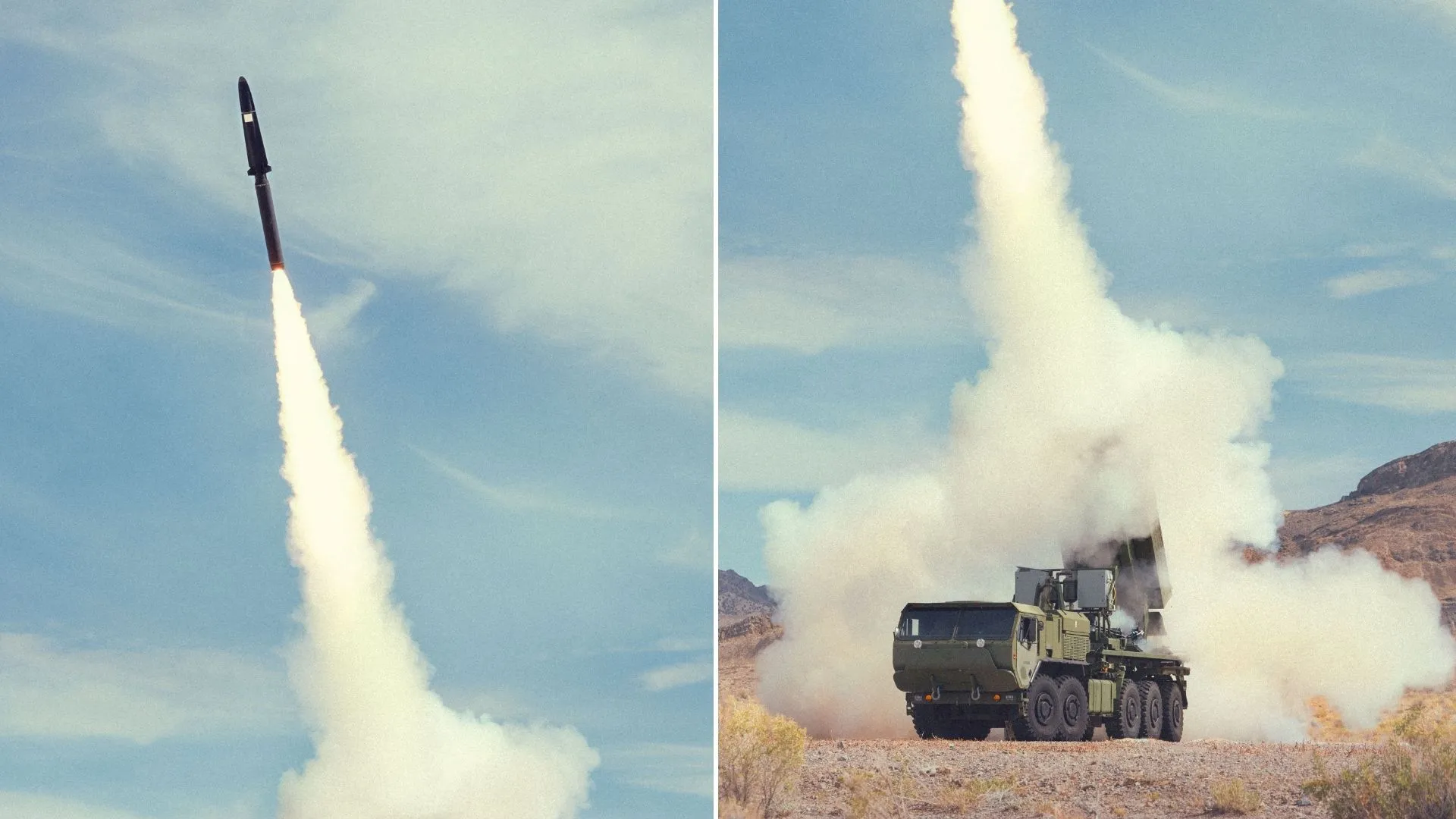
US defense startup Castelion has released what appears to be the first public image of its Blackbeard hypersonic missile fired from a ground-based system, offering a glimpse of a weapon the US Army is hoping to develop as a cheaper alternative to more expensive precision strike systems.
The photo shared by Castelion on social media shows a Blackbeard missile exiting an enclosed launcher mounted on a highly mobile military truck. The image provides a first look at the ground-based version, known as Blackbeard GL, and its container launch architecture.
The launcher appears to be designed to fit into the US Army’s existing mobile rocket artillery ecosystem. However, it remains unclear whether the configuration pictured represents the final production design.
A hypersonic missile designed for mobile launchers
The Army’s development plan calls for an initial ground launch demonstration using a modified Multiple Launch Rocket System Family of Munitions (MFOM) capsule. This would be followed by Blackbeard GL prototypes and a dedicated launch vehicle, with the longer-term goal of conducting a flight test of a Minimum Viable Product using the M142 High Mobility Artillery Rocket System (HIMARS) fire control system.
The Army’s fiscal year 2027 budget documentation lists a live-fire launch of a production-representative Blackbeard GL and launch vehicle as a planned milestone. The newly released image shows a compact, enclosed launch container mounted on a military truck chassis. The vehicle reportedly appears to be consistent with an Oshkosh logistics truck that Castelion had previously discussed converting for launch testing.
The image does not confirm how many rockets the launch vehicle can carry or how closely the test configuration matches the eventual production system. Castelion has emphasized that its test hardware is intended to support rapid development and should not necessarily be viewed as representative of the final weapon.
Larger scale, cheaper hypersonic weapons
Blackbeard is being developed with an important challenge for the US military in mind. Making hypersonic weapons so affordable that they can be manufactured and deployed in much larger numbers.
The Army has described the weapon as an affordable, mass-produced precision firearm designed to attack time-sensitive, moving and resilient targets. Their stated goal is to deliver approximately 80% of the capabilities planned for the Army’s Precision Strike Missile Increment 4 at a significantly lower cost per missile.
Hypersonic weapons reach speeds in excess of Mach 5, but speed alone does not determine how difficult it is to intercept a weapon. Their flight profiles and maneuverability can also make detection and defense difficult.
The Army’s existing long-range hypersonic weapon Dark Eagle relies on specialized launch equipment. In contrast, Blackbeard is being developed using a more compact approach that could make it easier to integrate into existing mobile launch infrastructure.
The exact propulsion system, flight profile and performance specifications of the production rocket remain secret. Castelion has previously suggested a range of about 500 miles, although ground launches could reduce that range compared to aircraft launches.
The Marine program adds another avenue to the mission
Blackbeard isn’t just limited to the Army’s ground launch effort. Castelion is also working to integrate the missile into the U.S. Navy’s F/A-18E/F Super Hornet fighter aircraft. In April, the company was awarded a $105 million Navy contract to support integration and transition to early operational capability.
A subsequent $23.4 million contract included 50 pre-production early operational capability missiles, as well as storage and transport containers. The Pentagon has also outlined ambitious potential procurement plans for the Army version.
In May it said that after successful testing and validation, a two-year, multi-year procurement contract for at least 500 Blackbeard missiles per year could be concluded. The ministry also said it is seeking approvals and funding to purchase more than 12,000 missiles over five years.