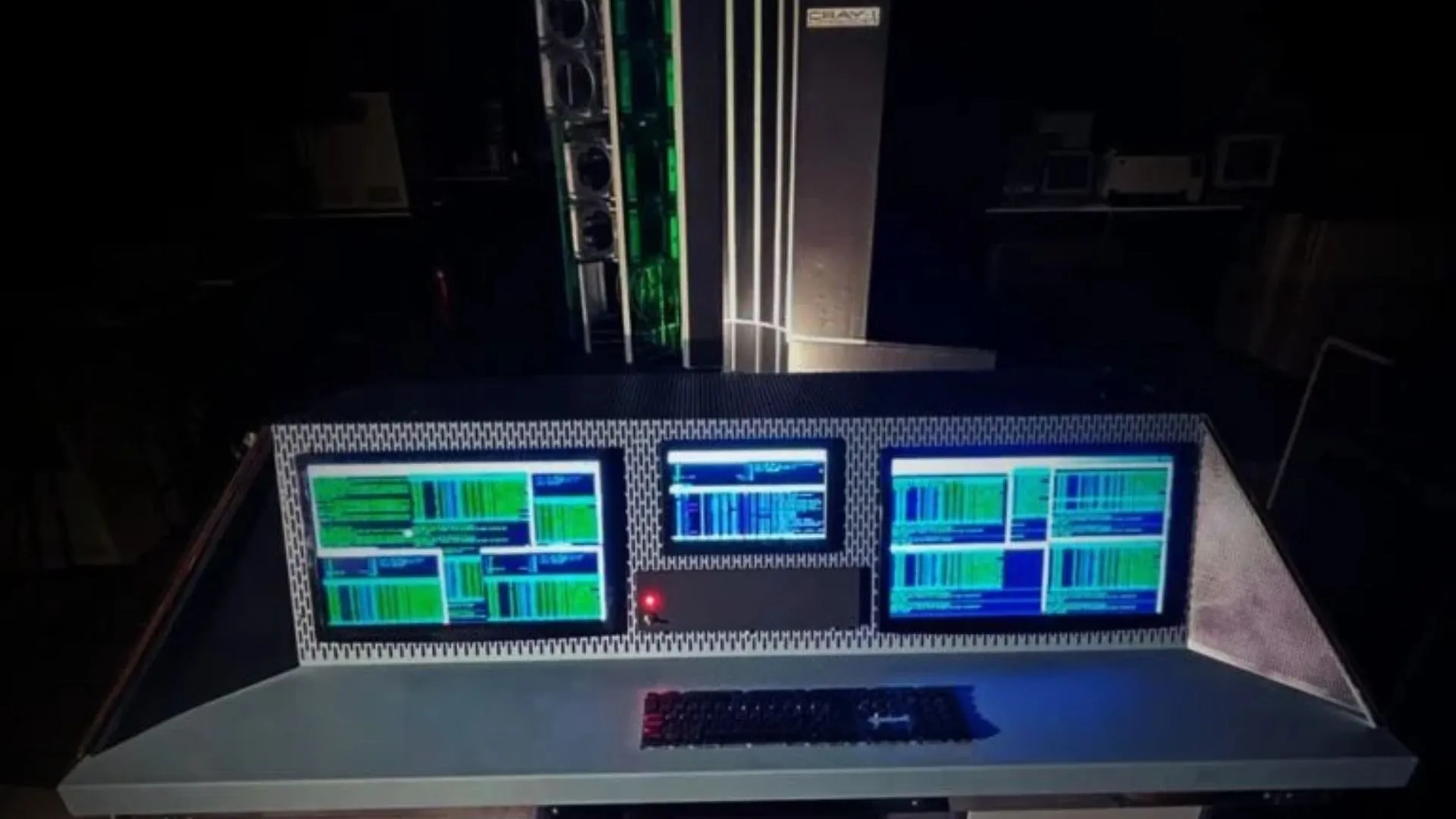
As a fitting tribute to the 50th anniversary of Apple’s founding and the first use of the Cray-1 supercomputer, the Museo de Historia de la Computación in Spain unveiled a replica of the Cray-1, built by repurposing 30 Mac Minis. The project took 18 months to build and is now open to the public.
At first glance, the idea of building a replica supercomputer with processing power from vintage chips seems pretty hopeless. However, it is important to remember that although the Cray-1 was the world’s first commercially successful supercomputer, it was first commissioned at Los Alamos in 1976. There’s a big gap in the processing power of today’s chips and those released a decade ago.
Imagine if you could extend this to five decades, taking Moore’s Law into account. While the processing power of a single modern chip may still be less than that of Cray-1, the difference becomes obvious when you put chips together from 30 Mac Minis from 2012-14.
A 9,375x jump
The museum team sourced 25 dual-core i5 units and five quad-core i7 units, increasing the replica device’s total computing capacity to 1.5 teraFLOPS. In comparison, the original Cray-1 had a peak capacity of 160 MegaFLOPS. This is still a 9,375-fold jump over the capabilities of the original supercomputer and shows how powerful chips have become over the years.
However, Cray-1 was still an extremely popular system in its day, selling more than 80 installations in its time. It gained popularity among science and engineering institutes that wanted to process huge data sets to make accurate predictions in areas such as weather forecasting, aerodynamics and even nuclear physics.
Crucial to the company’s ability to crunch these numbers was not just the hardware, but also the way it processed the data. Cray-1 introduced the power of vector processing, which processed data in parallel, saving valuable time by avoiding the sequential processing that computers did at the time.
Improvements with a touch of nostalgia
Back in 1976, the Cray-1 supercomputer was cooled via a large network of cooling pipes connected to a 20-ton refrigeration compressor in a separate room. However, for the replica, the museum designers took a passive cooling approach, building a vertical convection tower made of aluminum shells and a steel casing to dissipate the heat generated by the processors.
This passive approach eliminates the need for mechanical fans to handle the heat of the processors, making the replica extremely quiet. The only noise coming from the system is that of the Ethernet switches at the base, but the team plans to replace them with silent models soon as well.
Instead of relying on Linux for distribution, the team chose Apple’s macOS Mojave (10.14) because it allows nodes in a cluster to forward tasks to each other. Visitors to the museum can even see the Cray-1 replica in action as it runs matrix algorithms and works between single-core and full-suite to demonstrate its computing power.
The design team also built a custom terminal that looks like a historical relic from the 1970s, but also integrated a Mac Mini to facilitate connection to other cluster nodes. The original plans also called for CRT monitors, but were eventually replaced by flat panel displays that offered easier connectivity.
The museum may have taken a shortcut here, but it is leaving no stone unturned to ensure that the Cray-1 replica finds its place in the TOP500 supercomputer list. This may require another 70-80 Mac Minis, but sourcing them shouldn’t be too difficult.
