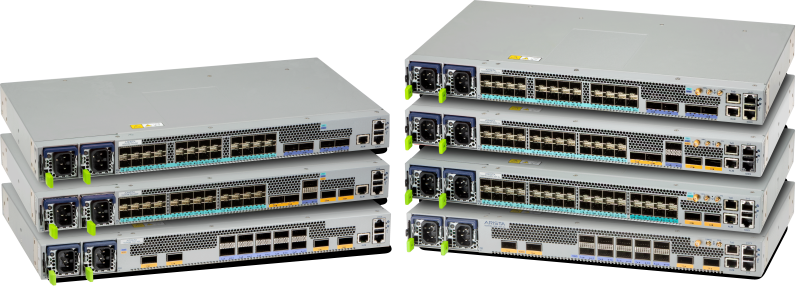
Awareness of the role of networking in AI has been steadily increasing, with much of the focus on the backend – larger clusters, faster ports, and scale-across fabrics that stitch together GPUs across data centers. Arista Networks Inc. experienced sustained, accelerated growth and was one of the biggest winners from this expansion.
This week at SC26Arista announced a shift in focus to the other side of the network. The company also announced a new line of Etherlink R4 routing platforms designed for so-called distributed inference, along with a pluggable optical line system for connecting data centers. The lineup includes:
- 7020R4 and 7020HR4: Compact 1RU access routers with 25G to 400G ports, deep buffers and optional wire-speed encryption on each port. The HR4 versions are temperature hardened and offer advanced timekeeping for cell sites and outdoor facilities.
- 7282R4: A fixed edge and core router with two supervisors for control plane redundancy.
- 7280R4: A 25.6 terabit “intermediate device” with 64 400G ports, half of which support ZR/ZR+ coherent optics, to connect local fabrics to the wide area network.
- Pluggable optical line system: A full C-band amplifier transmitting 25.6 Tbit/s over a single fiber pair, plus multiplexer and a pluggable fiber tester.
All are based on Broadcom’s Jericho And Qumran Silicon designed for up to 60% lower power consumption than competing 7nm and 16nm platforms. Everything is available now except the 7020HR4, which will ship in early 2027. The speeds and feeds always grab the headlines, but the impact of the starting point on where the AI infrastructure goes.
Inference is about to become widespread
During a preliminary briefing, Brendan Gibbs, AVP of product line management at Arista, argued that the forces driving training across multiple locations will have the same effect on the conclusion. Gibbs also said that about 30% of Arista’s AI business is now scalable, suggesting that distributed AI is quickly becoming commonplace.
The conclusion is spread for three reinforcing reasons:
- latency. A central cluster works well for a chatbot that streams text line by line. This doesn’t work with agent AI because a single request can trigger dozens of chained model calls and connections every millisecond.
- sovereignty. Regulators increasingly want inference requests and data to remain within national borders. European IT executives have little interest in sending data to U.S. cloud providers.
- Power and space. Enterprises will deploy inference wherever they have capacity, and the network must support this.
The implication is that the front-end network, long considered plumbing, now requires back-end attributes: deep buffers, traffic engineering, multi-tenancy and encryption as traffic now leaves the building.
Arista is going into the downmarket
This introduction is the opposite of the descriptions we normally associate with Arista. Recent announcements have focused on dense 800G, 1.6T and liquid cooling. The products presented at SC26 are smaller and cheaper. Arista dominates Big Iron and is now rounding out its portfolio. Arista’s customers range from hyperscalers to neoclouds to companies building on-premises AI. The front end needs rich functionality, not massive bandwidth, and Arista hasn’t had a viable option for this tier until now.
These routers are designed to be entry-level routers but ship with 400G uplinks, which may seem excessive today but provides investment protection. Gibbs said the goal is a 10-year life cycle where customers replace the optics rather than the body. No one knows what agents will do with traffic, and I suspect that companies considering this overkill today will think differently in three or four years. The headroom is cheaper than a forklift upgrade at a remote location. Also notable: Arista co-developed the 7280R4 with a hyperscaler that was looking for a bridge from gray to coherence, a sign that the company is working with its biggest customers.
The service provider placeholder
The most intriguing product is the hardened 7020HR4, designed for 5G and AI-RAN cell sites. Telcos have largely sat out AI expansion but own the last mile and real estate near users, exactly what low-latency inference requires. This gives a network operator the backbone to offer a managed AI factory.
In my opinion, this works better outside the US where companies don’t trust carriers beyond connectivity. In Europe and Asia Pacific, managed services are much more common and providers such as BT, NTT and Telstra have the presence to make this possible. Given sovereignty requirements, the opportunities for telecommunications companies to rise in the rankings have never been greater. Telcos have never been a core market for Arista, so any growth in this audience adds to their already massive TAM.
Quality and safety are the silent distinguishing features
Since 2019, Arista has reported far lower CVE numbers than competitors, even after the rise in AI-powered discoveries following Anthropic’s Mythos. I’m skeptical of CVE comparisons because the number depends on testing accuracy, installed base, and reporting practices, and some vendors now bundle multiple issues into a single CVE.
The more relevant benefit is operational. Customers often don’t apply patches because upgrades cause downtime and break things. When they trust the software, they patch faster and the window of risk shrinks. As Mythos accelerates the retirement of devices whose support has expired, quality and durability become purchasing criteria and not “nice-to-haves”. During the call, Gibbs agreed that it is difficult to draw conclusions from the CVE numbers, but explained that the CVE numbers are a measure of Arista’s software quality. This has been Arista’s calling card since its inception. While CVEs provide a metric, the larger proof point is the historical track record of quality software.
Additionally, MACsec and IPsec with line speed on each port are a differentiator as AI brings different security requirements. However, integrated security does not replace firewalls. I asked Gibbs about this and he said that Arista has no intention of replacing firewalls and expects Palo Alto Networks to continue to stand behind it. I would like to see this formalized in validated designs for distributed inference, just as Nvidia validated designs have done for the backend.
The optical line system is a similar simplification game. Arista is not a fiber company and resells these products, but offering a turnkey, EOS-integrated way for dark fiber customers to transmit 25.6 Tbit/s over a metro network eliminates a real headache.
Customers have responded positively to Arista’s entry into this market. Douglas Fast Net CTO Jon Vradenburg said the company needed “a compact platform that supports the services our business and carrier customers rely on.” Takayuki Sakou from Japan’s STNet cited “higher throughput and improved energy efficiency while maintaining the quality of the EOS software we trust.”
Considerations for Network Professionals
- Map where the inference is running, not just where it is running today. If your AI roadmap includes agents, assume latency and sovereignty will bring inference closer to users and plan the frontend accordingly.
- Treat the frontend as part of the AI structure. Assess buffering, traffic engineering, and multi-tenancy at the WAN edge with the same care you apply to GPU clusters.
- Set encryption as default. Inference traffic between websites contains prompts and proprietary data. Wire-speed encryption should be the be-all and end-all.
- Buy to last. Prioritize platforms with uplink headroom, modern silicon, and a software track record that allows you to patch without fear.
Final thoughts
The back end of AI networking is largely a solved architecture at this point. The front end is not, and that is where the next round of competition will take place. With R4, Arista is betting that its routing credibility, quietly built on hyperscaler backbones, can make it standard there too. Considering how much traffic Agent AI is expected to generate, it’s a bet that, like most Arista bets, will likely pay off.
Zeus Kerravala is a Principal Analyst at ZK Research, a division of Kerravala Consulting. He wrote this article for SiliconANGLE.
Image: Arista
Support our mission to keep content open and free by interacting with theCUBE community. Join theCUBE Alumni Trust Networkwhere technology leaders connect, share information and create opportunities.
- Over 15 million viewers of theCUBE videosto spark conversations about AI, cloud, cybersecurity and more
- Over 11.4k theCUBE alumni — Connect with more than 11,400 technology and business leaders shaping the future through a unique, trusted network
Founded by tech visionaries John Furrier and Dave Vellante, SiliconANGLE Media has built a dynamic ecosystem of industry-leading digital media brands, reaching over 15 million elite tech professionals. Our new proprietary theCUBE AI Video Cloud is a game-changer in audience engagement, leveraging the theCUBEai.com neural network to help technology companies make data-driven decisions and stay at the forefront of the industry conversation.
