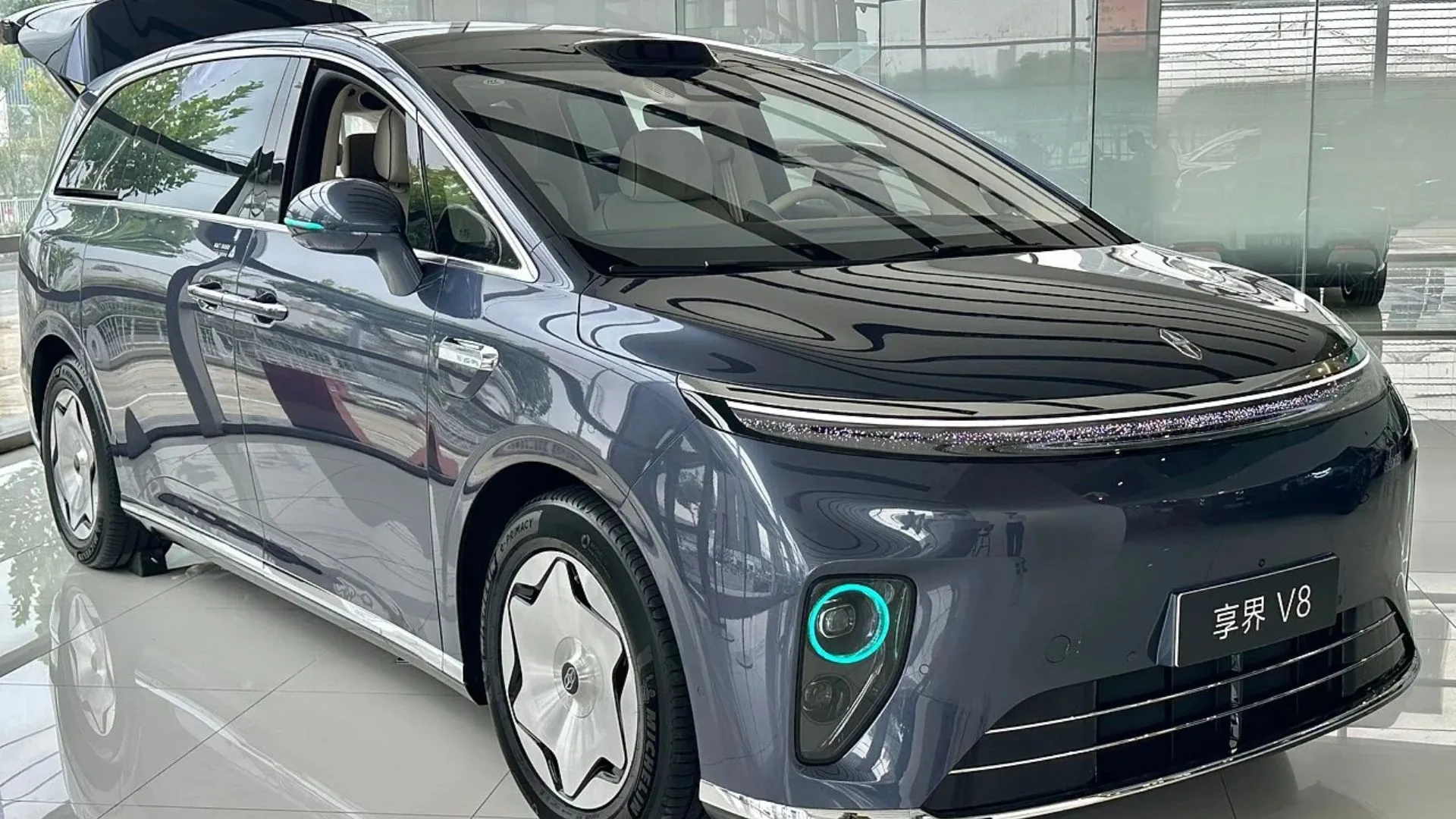
Stelato launched its flagship V8 minivan in China on November 20, offering a seven-seat model that can travel up to 910 miles on the China Light-Duty Vehicle Test Cycle (CLTC) in its extended-range configuration. The all-electric version is designed to provide a range of up to 516 miles on the same cycle.
The BAIC-backed premium brand, part of the Harmony Intelligent Mobility Alliance, offers seven trim levels across the two powertrains with two- and four-wheel drive configurations.
Both versions use an 800-volt electrical platform. Stelato also equipped the V8 with rear-wheel steering to help maneuver a vehicle that stretches about 210 inches from bumper to bumper.
A 15 minute charge adds up to 249 miles
The battery-electric V8 uses a 120 kWh battery from CATL. The battery uses ternary lithium chemistry. The rear-wheel drive model produces 305 hp, while the all-wheel drive version increases output to 519 hp.
According to figures reported at launch, a 15-minute charge can increase the electric model’s rated range by around 249 miles.
The extended range version has a 1.5-liter turbocharged engine and is equipped with either a 56 kWh or 75.4 kWh battery. Its 910-mile rating represents the combined range on battery power and fuel.
The second row seats rotate backwards
The V8 is about 79 inches wide and 71 inches tall, with a wheelbase of about 128 inches. Stelato calls the closed front section a “whale nose” design and uses the “Harmony Star Ring” design on the outside.
The minivan has a drag coefficient of 0.226. The power sliding doors open to a width of approximately 29 inches, and the cabin floor is approximately 15 inches above the ground at the entrance.
In the interior, the seats are arranged in a two-two-three arrangement and are covered in nappa leather. The second-row seats can rotate 45, 90 or 180 degrees, allowing passengers to face the doors or the third row.
You can also slide sideways along a track about 42 inches long. Stelato describes the chairs as zero-gravity seats and says each features 16-layer construction.
A three-screen dashboard runs Huawei’s HarmonyOS cockpit software. Rear passengers get a 21.4-inch overhead display, while a 25-speaker Huawei audio system delivers up to 2,080 watts.
The cockpit supports vehicle-to-home communication, integrates with compatible smart home devices and can be connected to a Nintendo Switch console.
Four lidar units support driver assistance
Huawei’s Qiankun ADS 5.0 driver assistance system uses 38 sensors, including four lidar units. The V8 also uses Huawei’s CAS 5.0 collision avoidance system. Stelato describes the underlying architecture as ready for level 3 automated driving.
The Huawei Tuling chassis combines a double wishbone front suspension with an independent five-link rear axle and dual-chamber air springs. Rear-wheel steering is standard, with the rear wheels able to rotate up to 12 degrees in either direction.
The system also enables a “crab walk” mode, which allows the minivan to move diagonally by turning the front and rear wheels in the same direction. This gives the driver another opportunity to reposition the seven-seater in tight spaces.
