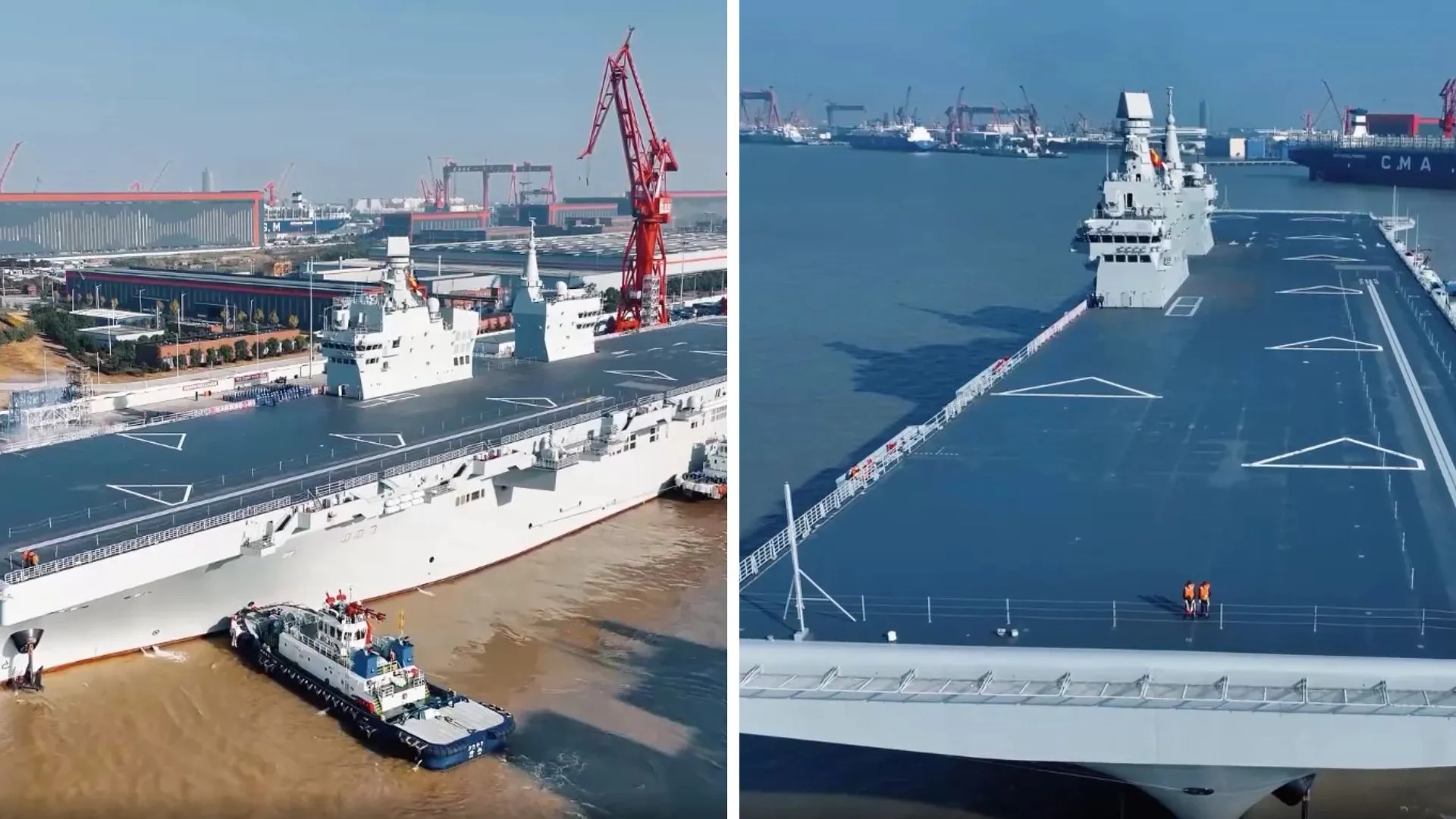
China has unveiled its new amphibious assault ship, which is also the world’s first catapult-capable drone carrier. The Type 076 ship, named Sichuan, can easily be used to operate stealth drones and serve as a large naval combat platform.
China carried out the successful launch and landing of the GJ-21 stealth reconnaissance and attack drone aboard the Type 076 Sichuan amphibious assault ship.
Attack ship equipped with an electromagnetic catapult
The Type 076 is unveiled as the world’s first amphibious assault ship equipped with an electromagnetic catapult system and capture technology and capable of supporting fixed-wing unmanned aircraft (UAVs).
The successful demonstration represents more than an advance in drone technology. It signals China’s increasing efforts to reshape the operational role of amphibious assault ships and strengthen the integration of unmanned platforms into its naval strategy.
Unlike traditional amphibious assault ships, which focus primarily on transporting troops, helicopters and amphibious equipment, the ship has technologies that enable the launch and recovery of large fixed-wing drones.
Carrier-based drone deployment
The ship’s electromagnetic catapult technology provides the ability to launch heavier fixed-wing aircraft that would otherwise have significant limitations when using traditional amphibious assault ships.
China’s advances in carrier-based drone operations are likely to attract significant attention from regional and global military planners, particularly in the strategically important Indo-Pacific region.
The operational effectiveness of the FJ-21 will depend on several factors, including its endurance, reliability, communications systems, maintenance requirements and its ability to conduct repeated missions in demanding sea conditions.
Ships like Sichuan are designed primarily to support amphibious operations, transport military personnel, deploy helicopters and facilitate landing operations. However, the integration of electromagnetic catapult technology and fixed-wing unmanned aircraft could transform them into versatile platforms for maritime surveillance, reconnaissance and strike missions.
The Sichuan could therefore serve as an independent drone carrier, contributing to broader naval operations alongside China’s conventional aircraft carriers.
Conventionally, such ships are designed primarily to support amphibious operations, transport military personnel, deploy helicopters, and facilitate landing operations. However, the integration of electromagnetic catapult technology and fixed-wing unmanned aircraft could transform them into versatile platforms for maritime surveillance, reconnaissance and strike missions.
The Sichuan could therefore serve as an independent drone carrier, contributing to broader naval operations alongside China’s conventional aircraft carriers.
The successful FY-21 demonstration comes as part of China’s broader efforts to modernize its navy and strengthen its ability to operate in remote maritime regions.
In recent years, China has invested heavily in aircraft carriers, advanced destroyers, amphibious assault ships, stealth aircraft and unmanned military systems. The introduction of the Type 076 adds a further dimension to this modernization program.
The development also signals a broader shift in naval warfare, where unmanned systems are increasingly becoming an important part of military planning.
