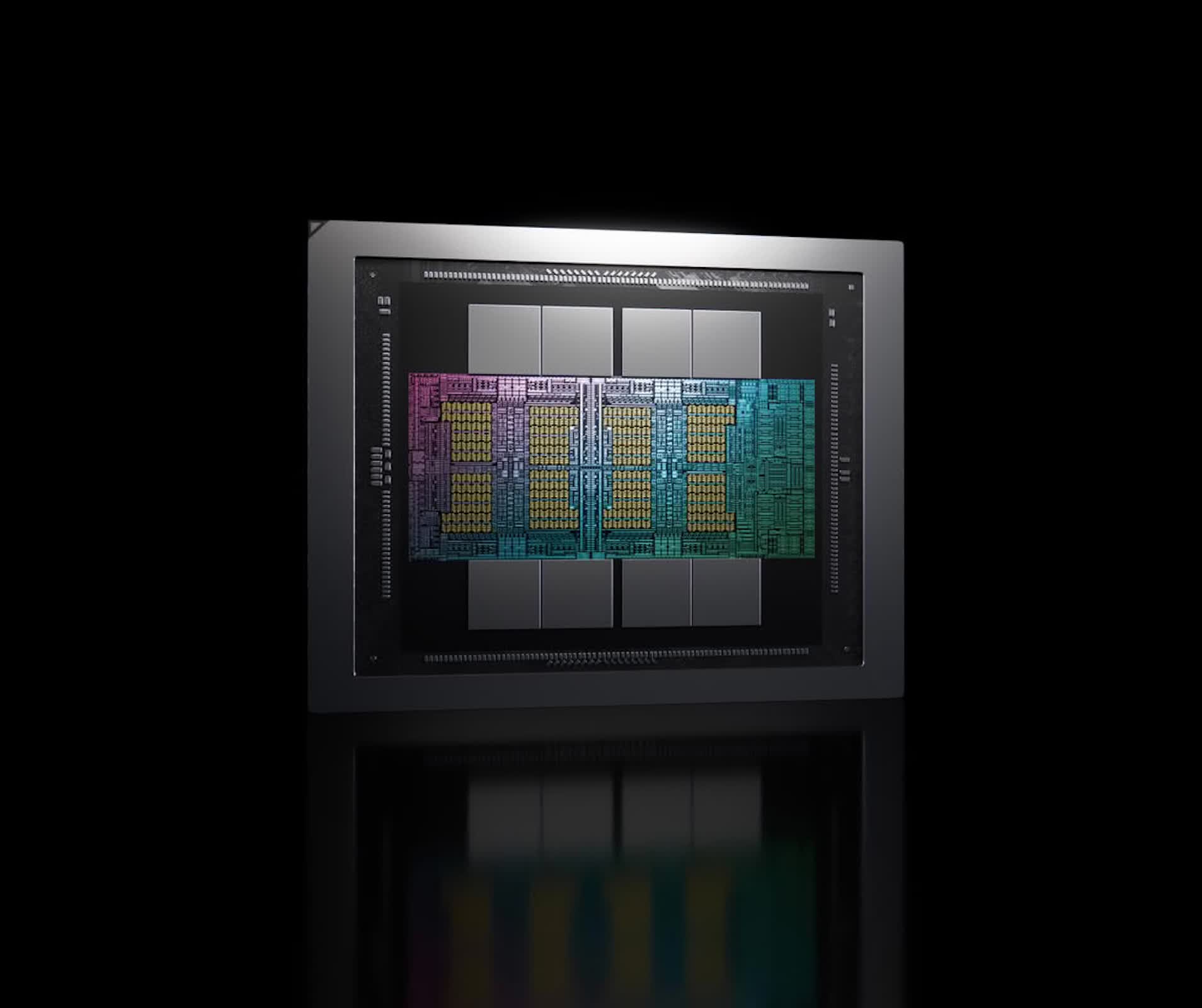
What we know so far: Nvidia is building a GPU with more than 50,000 CUDA cores for one primary task: running the simulations that AI agents run when they help scientists and engineers test ideas. The Ruby HPC chip was announced this week at the 2026 Supercomputing conference as a new part of Nvidia’s Vera Rubin platform, but it’s not expected until 2028, and the company has yet to release several specifications that are most important to HPC buyers.
The number of cores offers a first indication of what Nvidia is building. The current Ruby GPU has 224 streaming multiprocessors and 28,672 CUDA cores, so exceeding 50,000 would require at least 74% more cores.
This suggests that Rubin HPC could spread its cores across multiple chips in a package, like the two-chip Rubin does, or like the four-chip Rubin Ultra, which Nvidia originally planned and whose design has now reportedly been scaled down. Nvidia hasn’t confirmed the chip’s physical layout, only describing the core count as “on a single GPU.” The image released with the announcement does not appear to show a multi-die design.
Nvidia’s pitch is less about pure computing power and more about harnessing that computing power. The company says climate modeling, engineering simulation, genomic analysis and financial risk work tend to follow the same pattern: A program digs into a huge data set, pulls out a few scattered values, performs a calculation, and then repeats that step an enormous number of times. Under this type of load, a GPU’s cores often remain idle while waiting for data.
According to Nvidia, Rubin HPC addresses this problem with what it calls a “balanced design,” meaning that data movement scales with computing power rather than just adding computing power. Part of this design is a sparse data acceleration feature that Nvidia says powers the cores.
According to the company, it speeds up the routines that appear again and again in simulation code, including sparse matrix operations, stencil calculations, sorts and reductions. These routines are common in both scientific and commercial analytics, which is why Nvidia is touting the chip as useful for many industries rather than a niche lab part.
Between the GPUs, Rubin will use seventh-generation HPC NVLink. Nvidia did not provide any information about the bandwidth of the connection or the physical layer in the rack. For reference, NVLink 6 delivers 3.6 TB/s per GPU in the Vera Rubin NVL72, and previous roadmaps combined NVLink 7 with much larger scale-up domains.
Other details are also missing. Nvidia hasn’t specified the chip’s HBM capacity or memory bandwidth, nor has it said whether Rubin HPC silicon is switching to native FP64 math. This question is important because AMD is promoting far stronger double-precision performance in the GPU it is introducing at the conference.
Instead, Nvidia has aimed the chip at agent workflows. He believes AI agents will enable research teams to screen far more candidate materials, molecules and designs than humans could alone. Each of these candidates still needs to be tested in a simulation before anyone commits to a physics experiment or prototype. More agents mean more simulations, and more simulations mean more need for accelerated computing.
“For agents engaged in science and engineering, faster simulation means faster discovery. Rubin HPC accelerates the simulations agents use to test ideas and guide their next steps, helping scientists and engineers explore more possibilities and bring breakthroughs closer,” said Ian Buck, Nvidia’s vice president of hyperscale and high-performance computing.
Software is a big part of the plan. Agents running on Rubin HPC can leverage Nvidia’s CUDA-X libraries, a growing set of tuned implementations of complex algorithms, including many used in simulations and analytics.
When agents invoke optimized routines rather than writing their own, each round of hypothesis, simulation, and refinement should complete more quickly. This would allow researchers to decide on next steps sooner and focus lab time on the most promising candidates.
Rubin HPC is still more than a year away from release. Before that, Nvidia still has to announce how much memory the chip has, how it handles double precision and whether it uses more than one chip.
