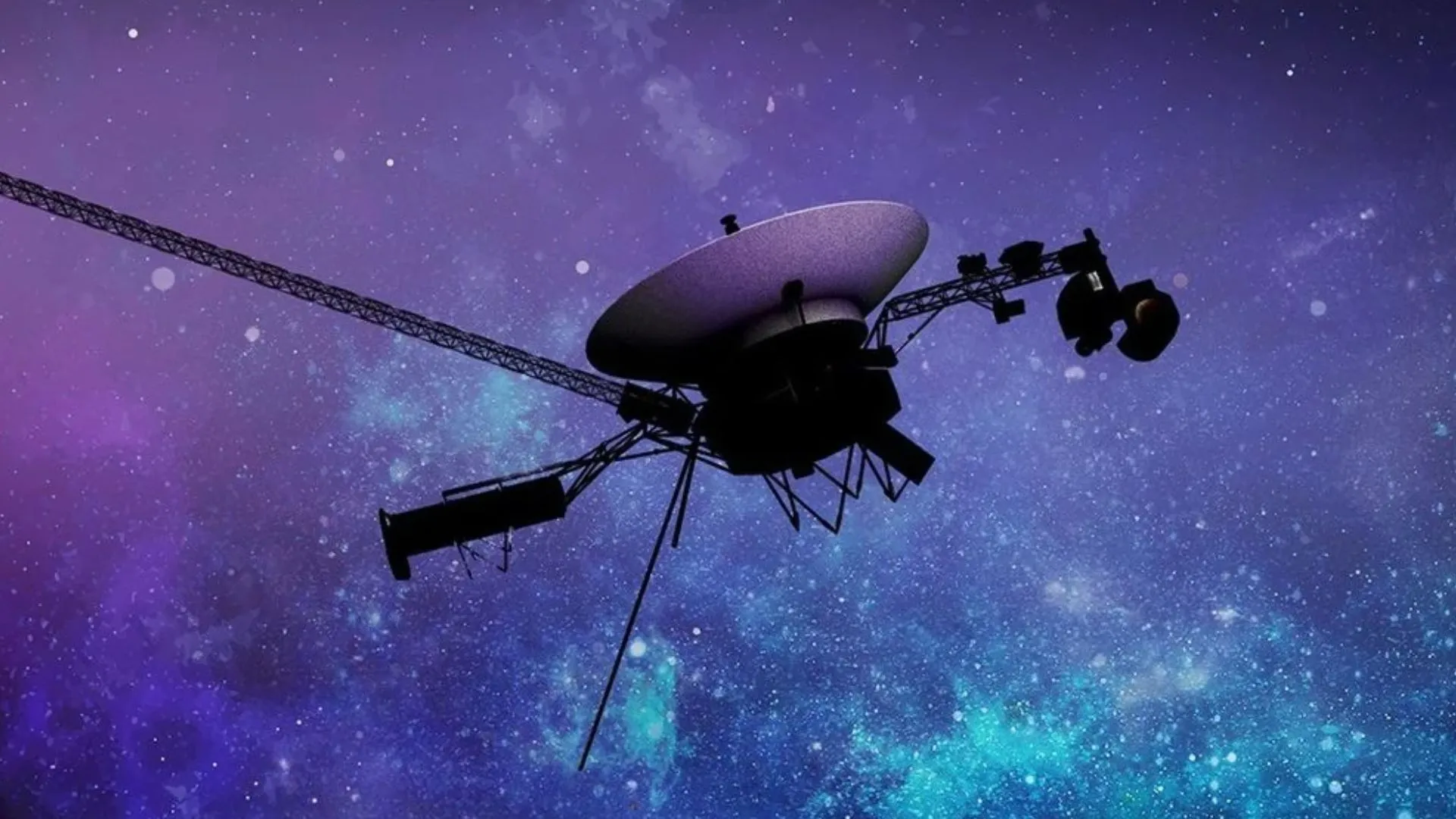
NASA briefly lost contact with Voyager 1 in mid-October after the nearly 50-year-old spacecraft stopped transmitting a detectable radio signal during two planned communications attempts. The signal returned on October 20, but engineers are still investigating what caused the disruption.
The incident comes just weeks before Voyager 1 is expected to become the first man-made object to reach a distance of one light day from Earth, a point at which radio messages take a full 24 hours to travel in either direction.
NASA’s Deep Space Network, a global system of large radio antennas used to communicate with distant spacecraft, failed to detect Voyager 1’s signal on October 18 and 19. The probe is now about 16 billion miles (24 billion kilometers) from Earth.
Communications resumed on October 20, about 48 hours after the disruption began. According to NASA, the team has maintained contact with the spacecraft since then.
An automatic security reaction could provide the clue
Engineers are still trying to figure out what caused the loss of communications. However, NASA has determined that a group of Voyager 1’s engines went offline during the incident, causing the backup engines to automatically turn on.
The spacecraft is programmed to respond in this way if its onboard computers detect a potential problem with the active engines. This automated protection system can place the probe in a stable, safe configuration and pause normal operations while engineers conduct investigations.
The spacecraft’s signal returned before the team sent commands from Earth to fix the problem.
“This is the first time we’ve seen the spacecraft do something like this, but we’re also at a point in the mission where we have to expect the unexpected,” said Kareem Badaruddin, Voyager mission manager at NASA’s Jet Propulsion Laboratory. “We are relieved to have regained contact with Voyager 1 and are eager to understand what happened.”
The incident is another reminder of the challenges of operating spacecraft launched nearly half a century ago, especially as their onboard power supplies continue to weaken.
NASA is trying to squeeze more life out of Voyager 1
Voyager 1 and its twin Voyager 2 rely on radioisotope thermoelectric generators (RTGs) that convert heat from decaying plutonium into electricity. Due to the decay of the radioactive material, the space probe loses around four watts of electrical power every year.
To keep the probes operating, engineers have gradually shut down instruments and other systems that are no longer essential to their missions.
In September, the Voyager team completed a major energy conservation effort on Voyager 1, nicknamed the “Big Bang.” Engineers simultaneously turned off three devices and activated lower-power alternatives, helping to reduce energy consumption while maintaining the spacecraft’s thermal balance.
The procedure was intended to extend the operational life of Voyager 1’s remaining science instruments. Without the changes, NASA estimates that another instrument would have had to be shut down in the summer of 2027.
Both spacecraft are now traveling through interstellar space, beyond the heliosphere, the giant bubble of particles and magnetic fields created by the Sun. They remain the only space probes that have directly examined this region.
24 hours waiting for news from Earth
Voyager 1 is approaching another remarkable milestone. On November 18, 2026, NASA expects the spacecraft to reach a distance of 16.094 billion miles (25.902 billion kilometers) from Earth, which is equivalent to one light day.
A light day is the distance that light travels in 24 hours. Since radio signals travel at the speed of light, it will then take a full day to reach Voyager 1. It will take another day for the spacecraft to receive a response.
This means that a simple probe replacement will take approximately 48 hours, even if everything works as expected. Voyager 1 is currently flying at about 38,000 miles per hour (61,155 km/h). After its launch in September 1977, it is the furthest man-made object from Earth, having traveled far beyond the planets it was originally sent to explore.
The one-light day milestone will not change the environment or the operation of the spacecraft. But it will provide an impressive measure of how far humanity’s most distant explorer has traveled and how long his signals must travel to reach home.
