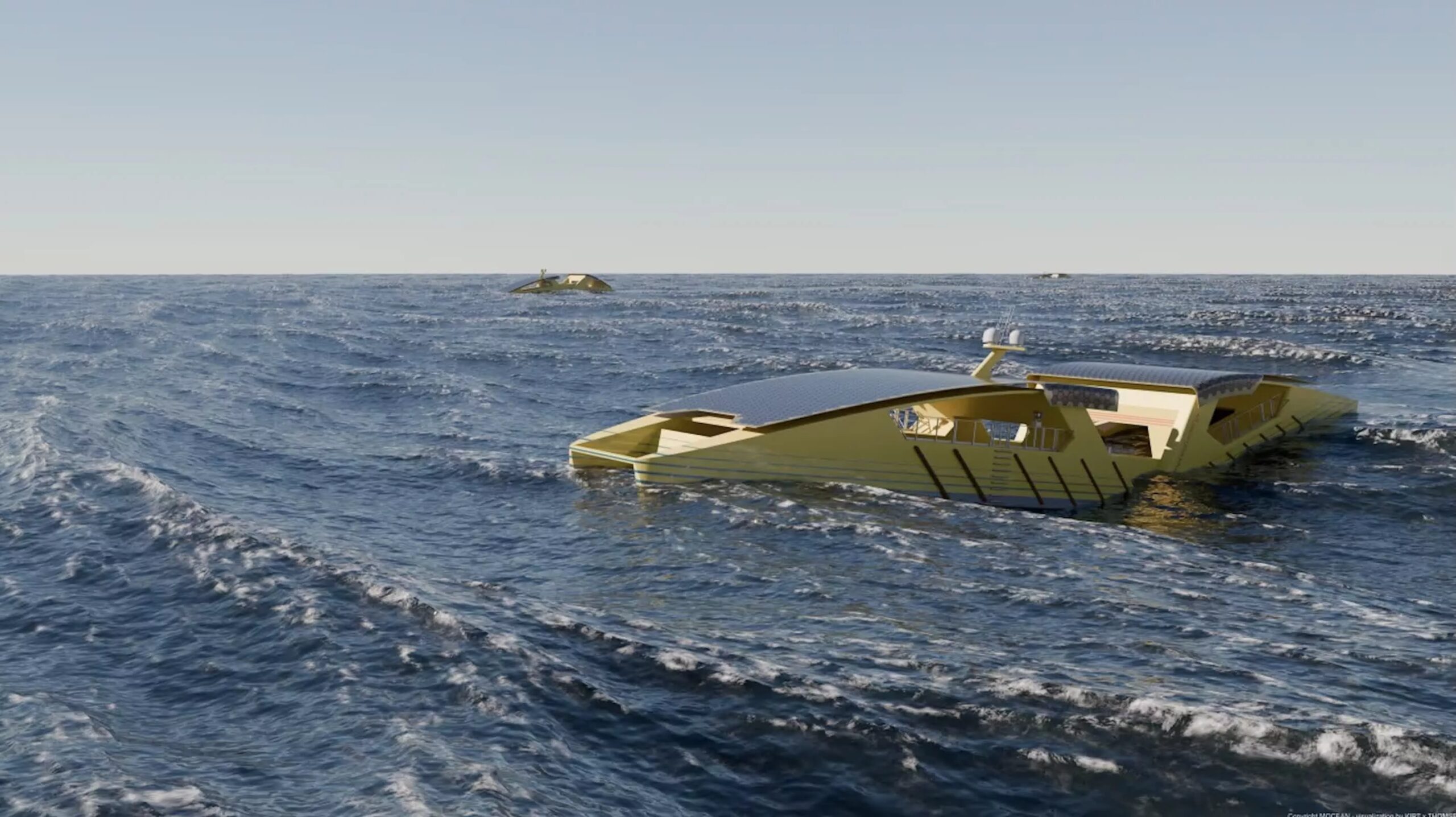
The big picture: A small group of companies are designing data centers that float on the open ocean or stand on the seabed, powering AI servers with power generated from waves, tides, wind and sunlight while releasing their heat into the surrounding water. The concept envisages a computing system that does not require a connection to the power grid, no municipal water supply and no residents who need to be convinced of its benefits. The biggest challenge is developing hardware that can withstand salt water, storms and marine life while harvesting enough energy from the sea to keep processors running.
The push for these facilities comes as battles over land-based data centers intensify. Local opposition often focuses on the power and water consumption of data centers and the location of their construction. Developers expect most of these arguments will be eliminated if the facilities are located miles offshore and have their own power and cooling systems.
There have been a number of announcements in recent months. In May, Portland-based Panthalassa raised $140 million from investors including Peter Thiel to build 278-foot-long steel structures that would float untethered in the Pacific and power AI computing using wave energy. The company plans to test its next-generation system before beginning commercial deployment in 2027.
In July, Scottish developer Mocean Energy announced it would install AI servers on floating vessels powered by waves and sunlight far offshore, cooled by seawater and connected to land via satellite. In October, New Jersey-based Ocean Power Technologies and Florida-based Stratum Holdings signed a non-binding memorandum of understanding to explore whether Ocean Power’s prototype buoys, powered primarily by wave, wind and solar energy, could support Stratum’s AI infrastructure without a power cable on land.
Other designs would stay closer to land. Massachusetts-based DeepGreen Holdings has applied for a federal permit to study tidal-powered underwater data centers on the ocean floor off Eastport, Maine, and in Cook Inlet, Alaska. The systems would exploit the movement of water near the coast during rising and falling tides. Japan’s Mitsui OSK Lines wants to build a new ship or convert an existing one into a port-moored data center powered either from shore or by a separate energy vessel.
Mocean provides the most detailed insight into how the hardware works. The system is the result of a decade of work developing wave energy technology for offshore oil and gas operators. A floating body moves with the waves and directly drives a generator, minimizing the number of moving parts that can fail. During a 13-month trial at sea that ended in spring 2024, the device generated power in waves up to 40 feet high, but output dropped in smaller seas.
This test facility generated around 10 kilowatts. Mocean now wants each node to provide about 500 kilowatts of power to onboard computers by combining wave and solar energy, with batteries serving as backup during calm, cloudy times. The company plans to group the nodes in clusters of up to 100 megawatts in high-energy wave regions such as Western Europe, the West Coast of the United States, Chile and Western Australia.
Cameron McNatt, the company’s co-founder and CEO, has set expansion goals of one gigawatt within five years and 10 gigawatts within a decade. He says the units are difficult to spot from land. “They’re really low profile and sit close to the water,” McNatt told the Wall Street Journal. “They would essentially be invisible.”
Energy is the central technical challenge. Bryson Robertson, director of the Institute for Integrated Energy Systems at the University of Victoria, says the cost of laying submarine cables on land can strain a project’s budget before the technology is proven. This explains why most of these structures generate electricity on site. Free-floating platforms save the cost of berths, Robertson said, but storms can push them off the station. The energy needed to bring them back is energy that cannot be used to run the servers.
Scale is another limitation. Robertson says wave converters need to be tuned to the period of local waves. Simply increasing the size of a device does not necessarily produce more energy from the ocean; it might actually capture less. “It’s like building a 500-meter-wide wind turbine, but there’s never enough wind to make it turn,” he says.
Then there’s the water itself. Michael Barnard, a climate technology consultant, says salt water quickly corrodes metal, while barnacles, mineral deposits and microorganisms build up on submerged surfaces. These can clog intake filters and clog the heat exchangers used to cool the servers. “If you put anything in seawater, it immediately starts to fail,” says Barnard.
Barnard doubts that wave machines can work reliably enough to make the concept viable. He also points out that sending repair teams abroad increases costs. Mocean plans to use marine-grade corrosion-resistant coatings and anti-fouling paints and tow the units back to port for scheduled maintenance.
Environmental issues further increase the complexity. In Maine, opponents of the DeepGreen plan point out that the Bay of Fundy is home to some of the world’s most endangered whales. Kristen Monsell, director of ocean litigation at the Center for Biological Diversity, which plans to participate in the federal review, says moving further offshore could lead to more boat traffic, increase the risk of whale strikes and create noise that disrupts the way whales eat and find mates.
She also raised concerns about water pollution and heat release into the surrounding area. Louis Wolfson, managing member of DeepGreen, says the company’s multi-year preliminary study is intended to examine these issues. He says the company only considers turbines that stay within safe acoustic limits for marine mammals and fish. Tribal leaders, fishermen and city officials are also consulted before applying for a license. DeepGreen is still evaluating equipment partners and hasn’t thrown anything in the water yet.
Wave energy has a long history of failed ventures, many of which came to naught due to harsh conditions and high costs. Robertson says deep-pocketed tech companies could give the field the financial support it needs to keep trying. “It’s nice to see the industry starting to spend money in the wave energy space,” he says. “No technology works the first time.”
