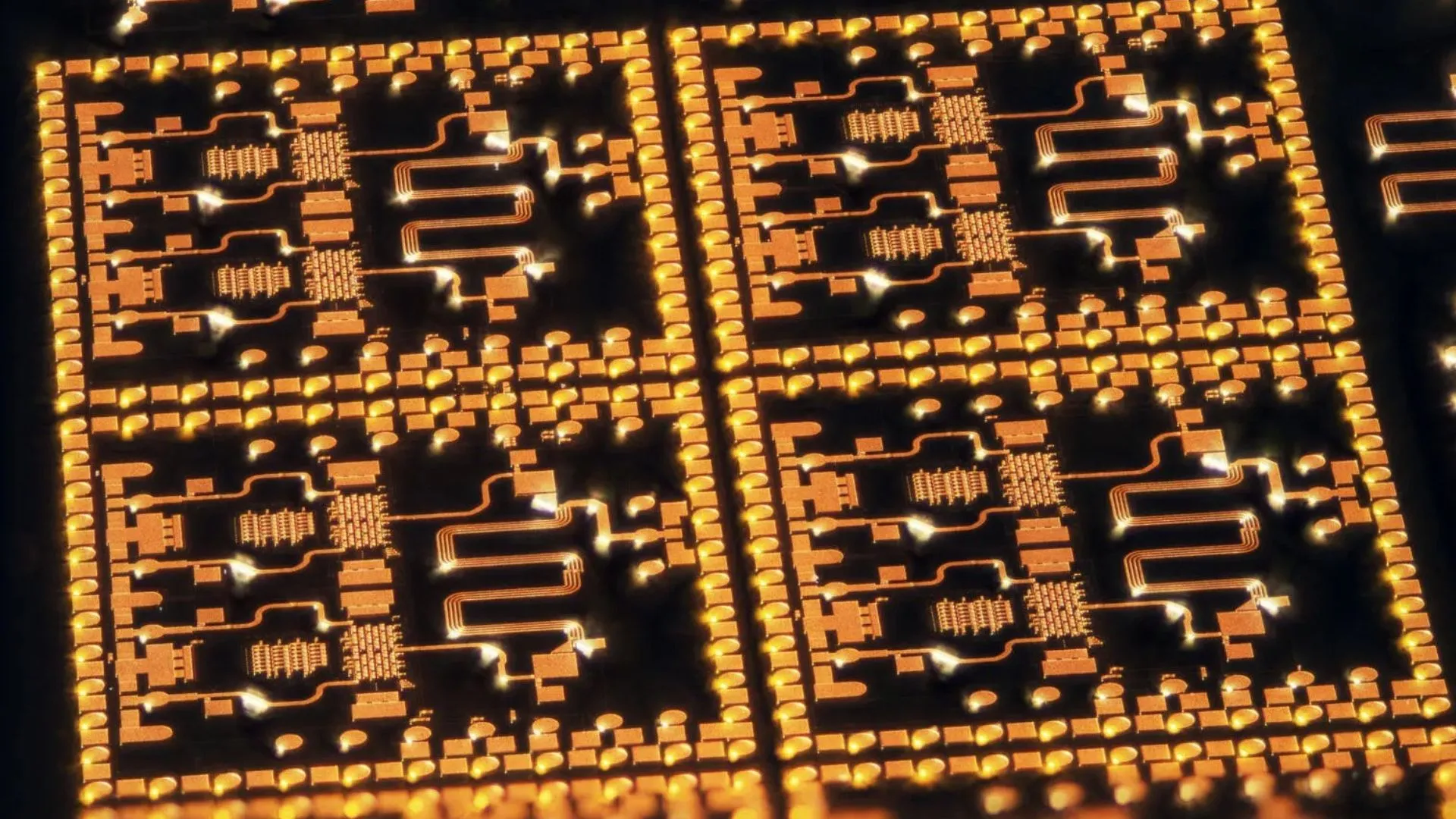
Northrop Grumman has unveiled a new gallium nitride chip designed to handle demanding high-frequency workloads with less hardware.
The FORTITUDE™ chip can combine signal switching and filtering in a single device. According to Northrop Grumman, it delivers three times more power and 20 times better signal quality.
This performance could be important for systems operating in crowded or noisy environments. The company cites satellites, radar, GPS, electronic warfare and future 6G networks as potential applications.
GaN gets a new structure
The chip is also small enough to fit into a package about the size of a grain of rice. Its compact footprint could help engineers reduce weight and power requirements in larger systems.
FORTITUDE uses a patented gallium nitride structure consisting of multiple ultra-thin layers. Northrop Grumman describes the architecture as a “superlattice.” The stacked layers control the movement of electrons through the semiconductor while increasing the charge density.
The company says the structure can carry about 10 times the charge of standard GaN chips. This higher density helps the device handle more power without simply increasing its physical size.
Thermal management also becomes important as RF hardware requires higher performance levels. The superlattice design aims to reduce energy losses during operation. The approach is based on years of research by Northrop Grumman in the field of microelectronics. The technology was previously known as Super Lattice Castellated Field Effect Transistor.
Switch and filter together
Most RF systems rely on multiple components to manipulate signals as they move through a circuit. FORTITUDE combines two important functions in the same semiconductor.
The device can switch signals at sub-nanosecond speeds while filtering unwanted frequencies. This combination allows electrical signals to be shaped before they reach other parts of a system.
According to Northrop Grumman, FORTITUDE can operate at frequencies in the kilohertz range up to 20 GHz. This broad range could support multiple radar and communications bands with fewer specialized components.
The company says the chip can replace dozens of components in some system architectures. This could reduce weight and simplify the electronics around the RF chain.
More signal in a crowded spectrum
Modern HF systems increasingly work alongside other transmitters and sources of interference. Military platforms face particularly challenging conditions when multiple electronic systems compete for spectrum.
FORTITUDE is designed to maintain cleaner signal performance under these conditions. Northrop Grumman says its architecture can provide clearer data while using less power.
The technology is also aimed at commercial systems. Future communications networks could place greater demands on RF hardware as operators move to higher frequencies and more complex signaling environments.
Northrop Grumman is developing FORTITUDE for both the defense and commercial markets in the United States. Its potential applications include communications, sensing and electronic warfare.
The technical challenge remains familiar, even if the hardware changes. More information needs to be transported through increasingly dense electromagnetic environments. FORTITUDE addresses this problem at the semiconductor level, combining more power and signal control in much smaller hardware.