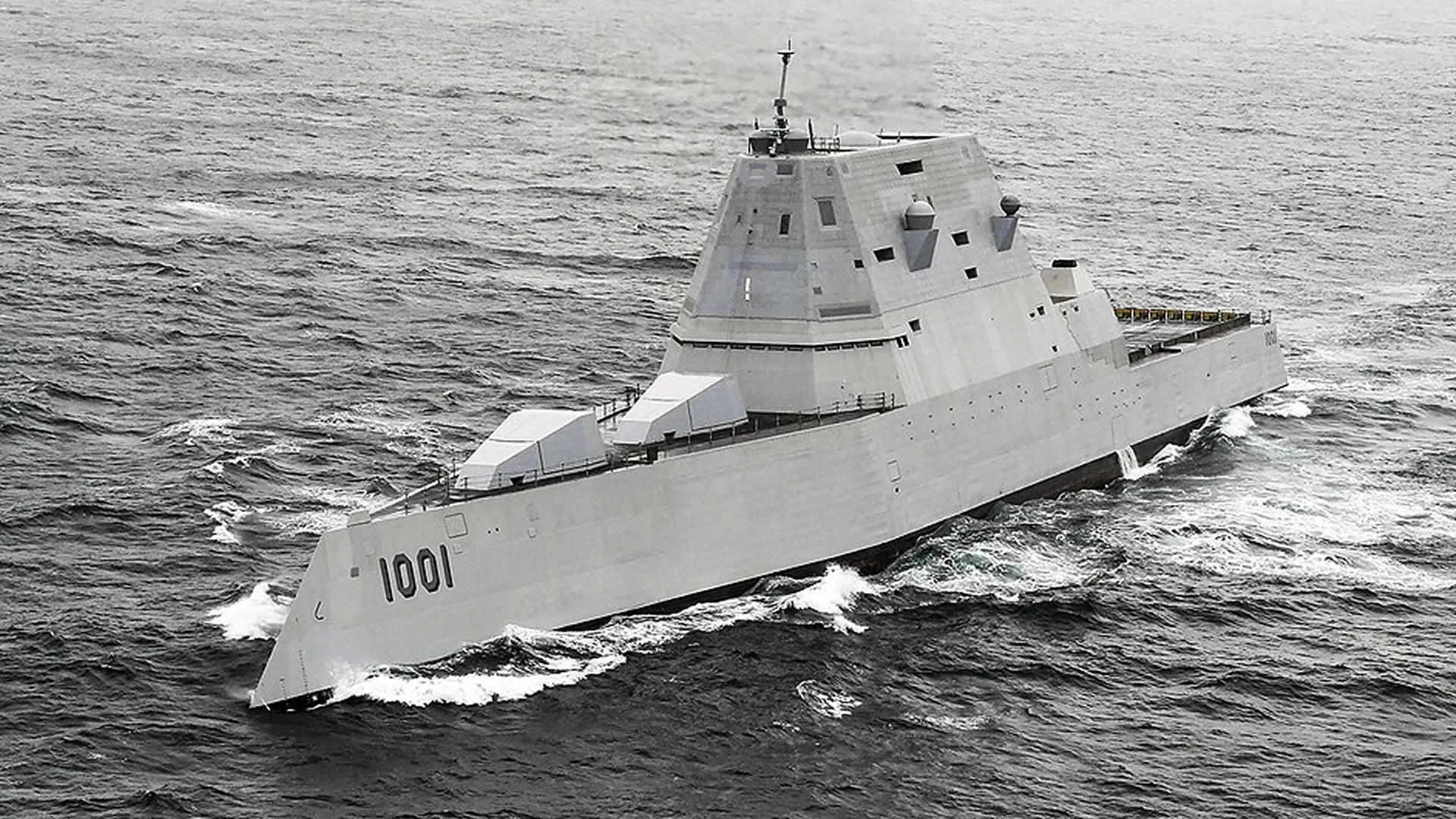
The United States Navy plans to install a new 600-ton hypersonic launch module Zumwalt-class destroyer USS Michael Monsoor (DDG-1001). If given the green light, this upgrade would effectively transform the ship from a massive, weaponized land bomber ship into a hypersonic missile platform.
Originally it was Zumwalt-class was designed as a multi-role warship with two 155 mm naval guns. However, ammunition for these guns became prohibitively expensive and the Navy abandoned the original ammunition procurement plan.
This left the Navy with three extremely expensive warships whose main armament was virtually useless for their intended mission. The Navy appears to have no choice but to find ways to reuse them.
For the USS Michael MonsoorThis includes replacing its guns with new vertical rocket launchers that can carry hypersonic Conventional Prompt Strike (CPS) weapons.
The upgrade would reportedly include four large launch tubes. Each tube will house up to three hypersonic missiles, giving the ship the ability to accommodate a total of twelve missiles.
Zumwaltclass gets a huge upgrade
The new module will be prefabricated and must be designed to fit into the warship’s hull without distorting its existing structure. Because that Zumwalt-Class has an unusual inward sloping hull, stability, weight distribution and access complicate everything.
Especially given that the new module will be approximately 13.6 meters long, 6.3 meters wide and 12.5 meters high. The modernization is scheduled to begin around May 2028 and hopefully be completed by August 2030.
The planned CPS hypersonic missiles have some important differences from conventional cruise missiles. One difference is the starting system.
A gas system ejects the rocket from its tube before the rocket motors ignite, reducing the load on the ship. The second point is how the rocket is accelerated.
This is achieved through a two-stage rocket that accelerates the weapon to hypersonic speeds. The third and most important phase is the sliding phase.
Hypersonic missiles use a maneuverable glide vehicle that separates from the booster and flies toward its target at more than five times the speed of sound. Unlike a traditional ballistic missile, its glide vehicle can maneuver during flight, making the trajectory more difficult to predict.
Can the industry supply enough rockets?
The big advantage is its ability to attack distant, heavily defended targets very quickly without using a nuclear warhead. All well and good, but having the rocket launcher installed is one thing. Actually fitting it with rockets is something else entirely.
According to a July 2026 Government Accountability Office (GAO) report, US industry is currently capable of delivering about 6 to 7 missiles per year. With everyone Zumwalt Twelve of each were needed, and it would take at least two years to fill the silos of each one.
And that assumes that any missile is designed for that purpose, especially given that the Navy shares the underlying technology with the U.S. Army. This all points to a broader problem for U.S. forces.
The country has the ability to develop high-performance technologies, but it is proving difficult to deploy them quickly and economically at scale.
There is a certain irony here. As these guns now give way to hypersonic missiles, the Navy faces another munitions problem, this time due to the inability to produce the weapons quickly enough.
In a sense, America’s brain is “writing checks that its body can’t cash.”
