Advanced nuclear power holds a clear promise: 24/7 low-carbon electricity with far better fuel efficiency than conventional plants. But the next generation of reactors faces a nuclear-scale obstacle. When uranium atoms split to produce energy, they leave behind problematic chemical byproducts that damage equipment and thwart recycling efforts.
A research team led by Pennsylvania State University has received $1 million from the U.S. Department of Energy to address this very problem. Their goal is to track and control three persistent fission products – samarium, europium and tellurium – in molten salt reactors and advanced recycling systems.
Commercially available reactors are cooled with pressurized water. But molten salt systems use liquid salts. These reactors can extract more energy from nuclear fuel and allow used materials to be recycled. However, the chemical soup it contains is known to be aggressive.
Each of the three target elements presents its own challenge. Samarium and europium are undesirable in recycled fuel because they can affect reactor performance and fuel recycling processes, the researchers said.
“Tellurium, on the other hand, can react with metals used in molten salt reactors and fuel recycling systems, contributing to corrosion and material degradation,” the researchers added.
Understand the basics
To solve this problem, researchers need to understand how these elements behave at a fundamental level.
“We will study the oxidation states of these elements, which describe how many electrons an atom has gained or lost and which greatly influences their chemical behavior,” said lead researcher Hojong Kim, a professor of materials science and engineering at Penn State.
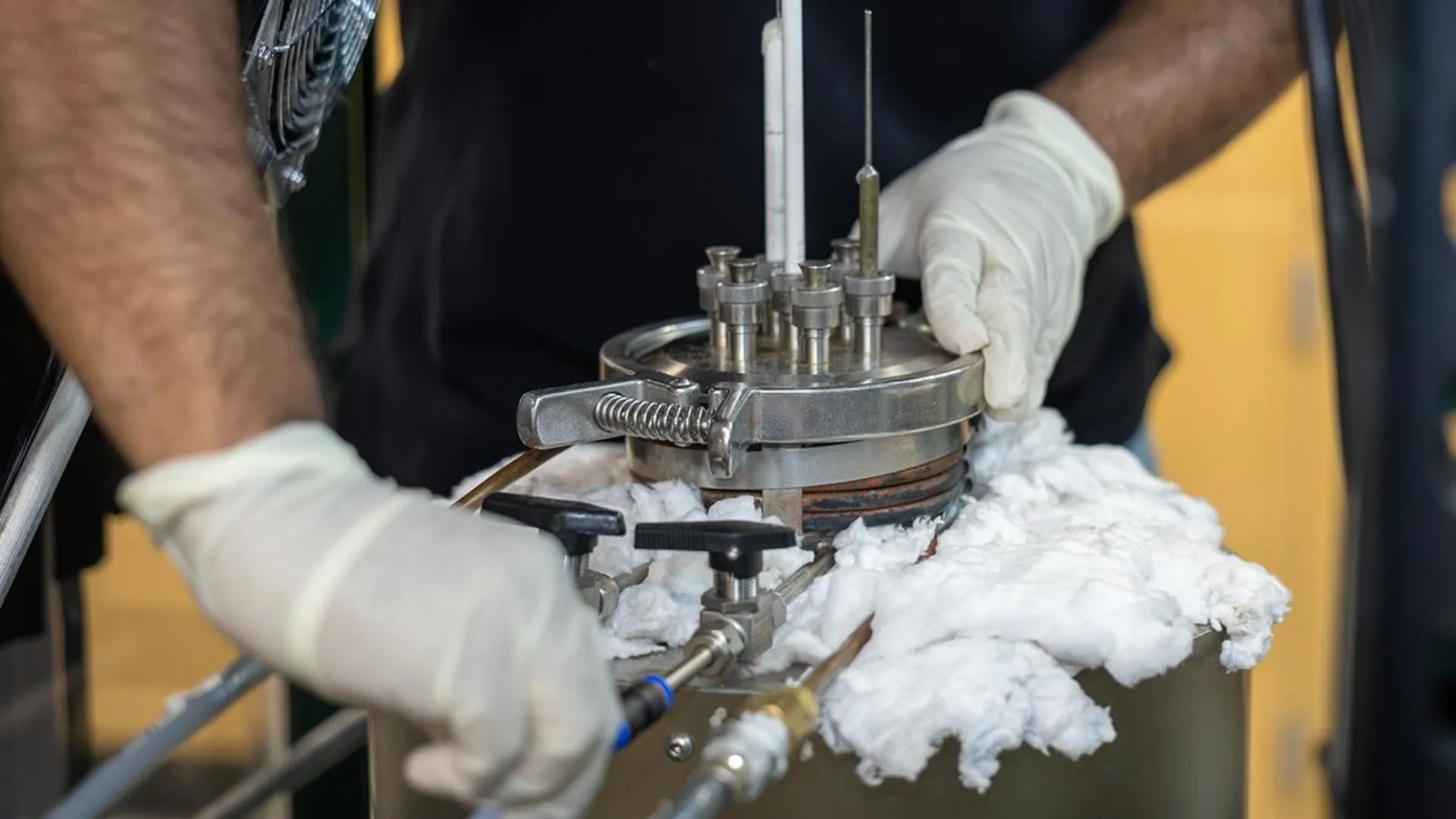
The team will study how these byproducts interact with reactor materials during pyroprocessing, a high-temperature recycling method based on molten salts. Working with specialists from the University of Nevada, Reno and the Idaho National Laboratory, researchers will combine computer modeling with direct laboratory experiments.
In the lab, graduate student Alok Pandey will dissolve the three elements in molten salt solvents and pass electric currents through the mixture. By varying the applied potential, he can observe how the elements shift their oxidation states.
“This will allow us to understand the electrochemical properties of the elements,” Pandey concluded. “It could help improve strategies for their recovery and management when recycling nuclear fuel.”
Solving the recycling puzzle
The project also revives an earlier, unsolved mystery. Kim had previously attempted to analyze samarium under a federal grant in 2018. These efforts failed because the element was present in tiny concentrations and behaved unpredictably compared to related rare earth metals. Equipped with newer diagnostic methods, the team believes they can now solve the problem.
Their solution relies on an unexpected ally: liquid bismuth. Kim’s lab previously discovered that molten bismuth can act like a chemical sponge, cleanly capturing rare earth elements from liquid salts.
If current trials are successful, the technology could enable more sustainable fuel cycles. By removing corrosive and performance-degrading byproducts, engineers can keep modern reactors running longer, extract more energy from each grain of uranium, and significantly reduce long-lived nuclear waste.