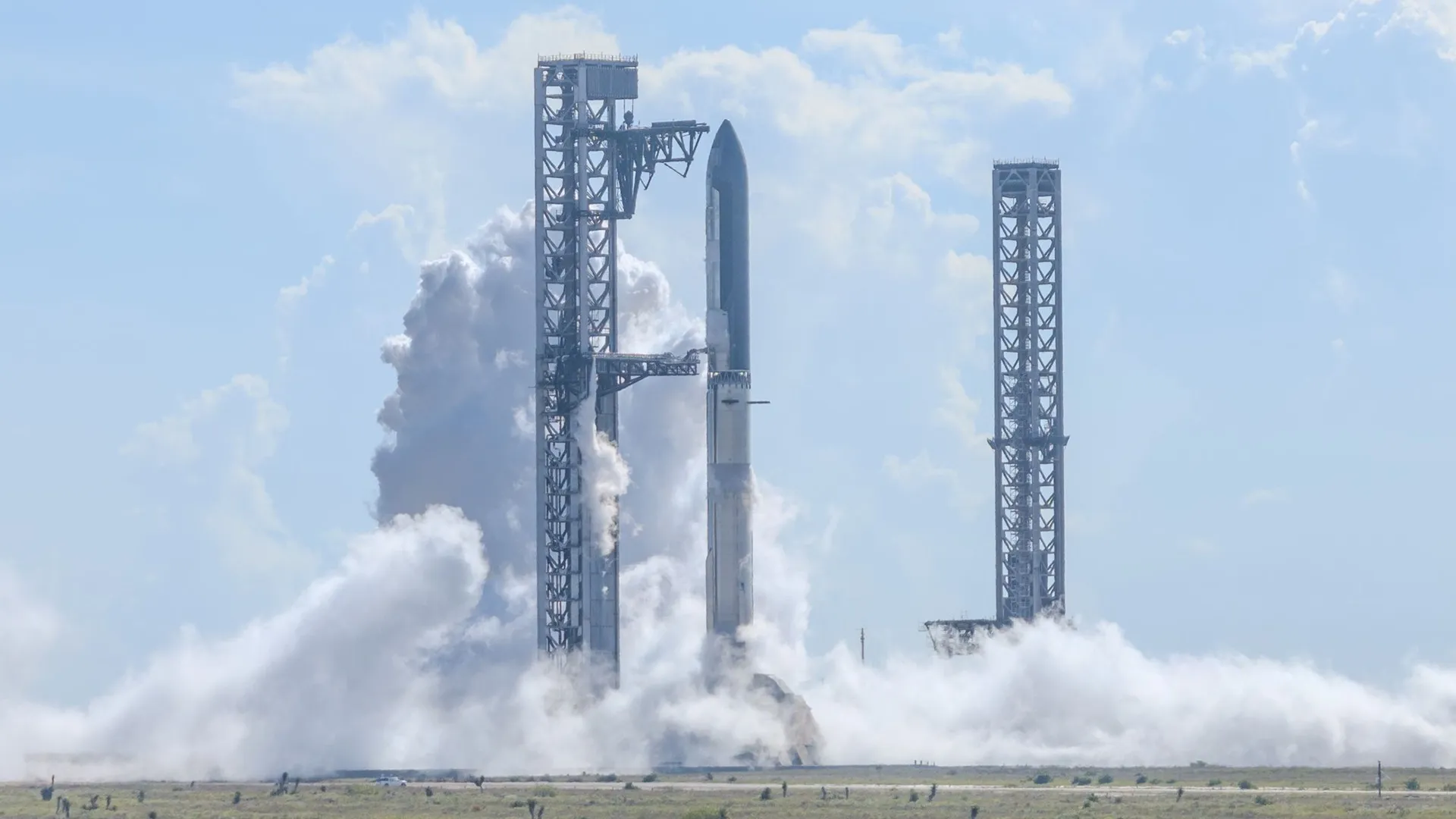
The world’s largest and most powerful launch vehicle, SpaceX’s Starship, just launched into orbit for the first time, deploying 26 of the company’s more powerful Starlink V3 internet satellites.
The unmanned Starship Flight 14 lifted off from the company’s Starbase location in Texas at approximately 7:46 a.m. CT on Monday, September 28. The historic departure was the spacecraft’s 14th integrated flight and the first aimed at sending the spacecraft into orbit around Earth.
The 124 meter high rocket consists of the Super Heavy booster and the Starship upper stage. If the mission goes as planned, Starship will reportedly complete about six orbits around Earth during a nearly 10-hour flight, its longest mission to date.
It will then sink into the Pacific Ocean west of Chile. The flight also marks the first time Starship has launched operational satellites into space. “Payload deployment complete. All 26 Starlink V3 satellites are in orbit,” reads one of SpaceX’s latest posts on social media platform X.
First flight on the way to orbit
SpaceX plans to deploy 26 Starlink V3 satellites during Flight 14, marking Starship’s first operational satellite deployment. Each satellite is designed to add one terabit per second (Tbps) of capacity to the company’s Internet network.
Together, the 26 satellites could add a total of 26 Tbit/s of capacity, which is about 10 times as much as a single Falcon 9 launch with V2 Mini Starlink satellites. In addition, the satellites should extend their antennas and solar systems. They will then make initial contact with ground stations and the rest of the Starlink constellation via radio frequency and laser links.
Image credit: SpaceX / Screenshot
They will then use their onboard engines to raise their orbits and undergo a check before beginning their mission. “Following their in-orbit testing, the satellites should begin customer support within weeks of launch,” SpaceX officials said.
In addition, SpaceX has equipped three of the satellites with cameras that will provide a look back at Starship and capture images of its heat shield after deployment. The images will allow the team to better examine the condition of Starship’s thermal protection system as SpaceX works to eventually return the spacecraft directly to its launch site.
Six trips around the world
All 13 previous Starship flights since 2023 have been suborbital. Flight 14 is intended to send the spacecraft into orbit for the first time. The spacecraft is expected to fly about 171 miles (275 kilometers) above Earth.
Still, the spacecraft will only perform its orbital insertion burn after flight controllers confirm that there is enough redundancy in the systems required for the eventual deorbit burn. At the end of the mission, it will fire a single Raptor engine in space to deorbit before performing a controlled reentry and landing.
Image credit: SpaceX / Screenshot
Flight 14 also includes changes from the previous test. During Starship’s Flight 13, Super Heavy used all 33 engines for its boostback burn for the first time. Ice later clogged three center engines, ending the maneuver early. The company therefore made hardware changes to improve engine filtering and software changes aimed at improving reignition reliability.
SpaceX continues to test multiple heat shield upgrades on Starship. These include additional mechanisms to hold the tiles in place and curved tiles designed to reduce heating in the spaces between them. Two heat shield tiles recovered from Ship 40 will be reused on Ship 41. This is the first time Starship has reused heat shield tiles.