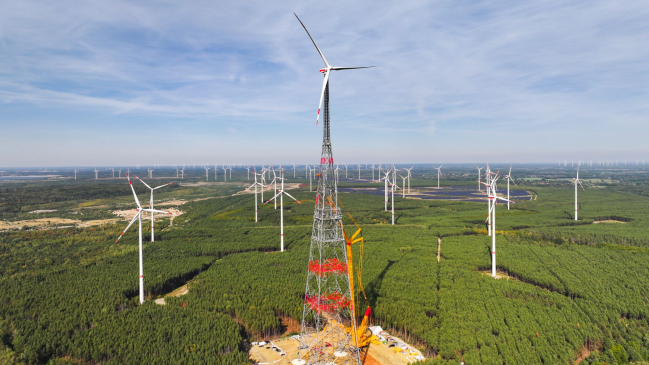
A nearly 1,200-foot-tall wind turbine has reached its full height in eastern Germany, creating a new approach to capturing wind energy at altitudes where the wind blows stronger and more consistently.
The pilot turbine in Schipkau was developed by the German engineering firm GICON for the Federal Agency for Disruptive Innovation (SPRIND) and is intended to test whether significantly more electricity can be generated from the same amount of wind infrastructure at a dramatic height.
The structure, including its rotor blades, reaches a height of 1,197 feet, making it the second tallest structure in Germany after the Berlin TV Tower. According to GICON, the design could ultimately generate about twice as much power as a conventional turbine with the same rotor diameter, although this estimate has yet to be proven in operation.
A wind turbine built to go higher
The main idea behind GICON’s design is to go where the wind is better. Wind speed generally increases with altitude, while higher altitudes can also provide more consistent wind conditions. Therefore, a turbine operating hundreds of meters above the ground has a larger and potentially more reliable energy resource than a traditional turbine.
The Schipkau pilot project has a nominal output of 3.8 megawatts, with future versions expected to reach more than 7 MW. The company’s forecast doubling of energy production refers to the electricity generated over time and not to the maximum rated output of the turbine.
However, to achieve this height, GICON had to rethink how such a turbine could be constructed. Instead of using a traditional crane that could reach the top of the tower, the company used a telescopic tower design.
A special lifting mechanism lifted the inner tower through a surrounding lattice structure and then secured it to its final height. Jochen Grosmann, founder and CEO of GICON, called reaching an altitude of 1,197 feet an important milestone for the project, which began as a concept before becoming a full-fledged pilot plant.
More electricity without new wind farms
One of the more interesting possibilities is that high-altitude turbines could be added to existing wind farms, rather than requiring entirely new sites. GICON and SPRIND envision the systems functioning as a second stage of wind generation, with the taller turbines positioned above traditional wind turbines. Therefore, their rotors would operate at higher altitudes while the existing turbines generate power lower down.
According to current estimates, up to 4,000 high-altitude turbines could be accommodated within existing wind farms in Germany. If the concept works as expected, this could enable additional power generation without the need to expand wind farms into new areas, while making better use of existing grid connections and developed wind energy sites.
While the completion of the structure represents an important achievement, the more important test is yet to come, with official commissioning scheduled for November after the remaining construction work is completed.
Once operational, the turbine provides the data necessary to determine whether the additional height delivers the expected increase in energy production and whether the benefits justify the additional engineering effort.