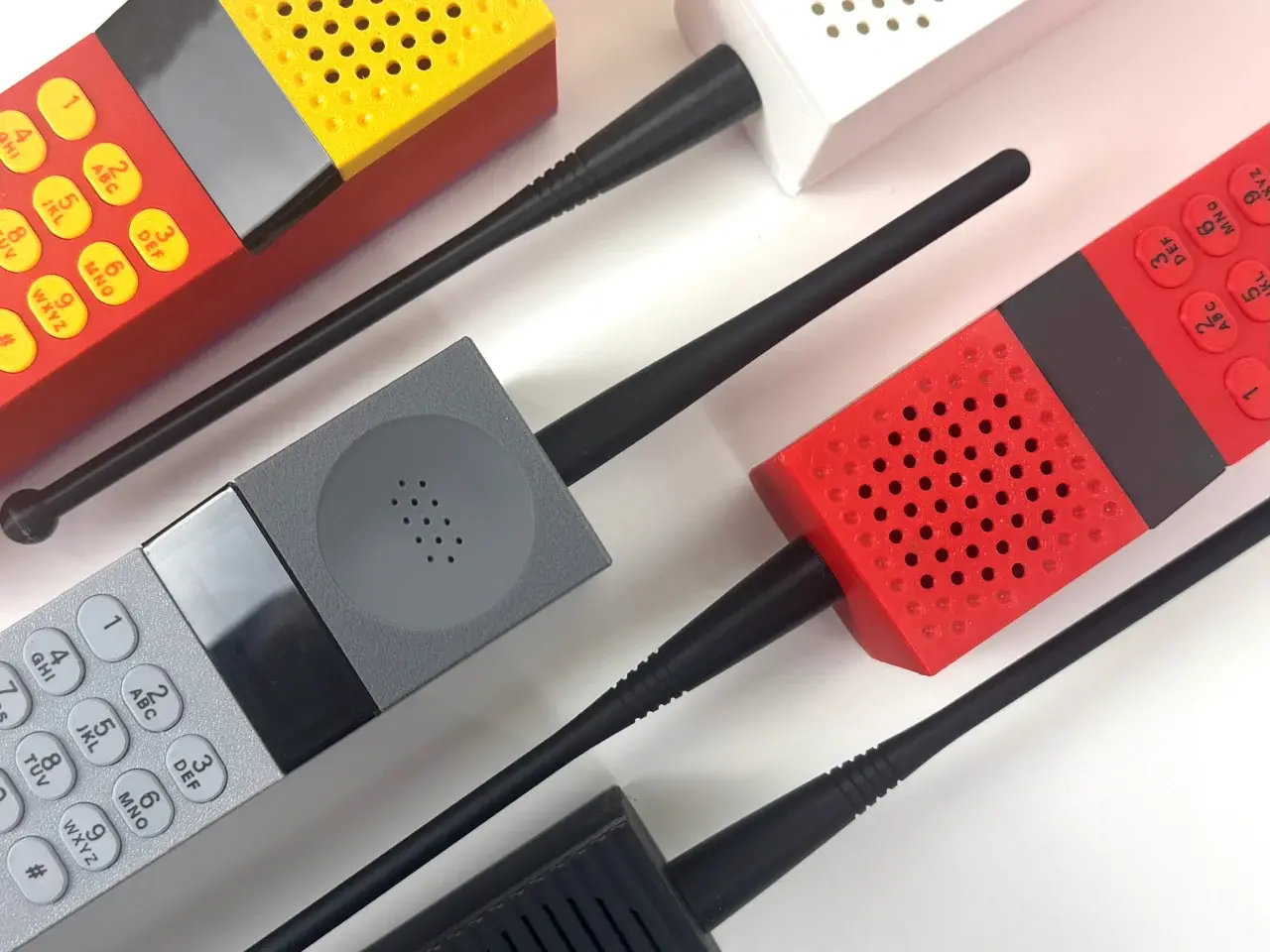
In short: Many people refer to the 1990s Nokia 3210 as the old-school brick-like cell phone. But for something that fits the description much better, go back another decade to the 1980s and the first portable cell phones: brick phones. Now a designer has 3D printed one of these devices while retaining the originals’ main function of making and receiving calls – so there are no distractions from modern smartphones.
Cologne-based designer and manufacturer Kevin Nokia created the ADHD ONE, the first part of the name being an acronym for Anti Distraction Handset Device.
The device resembles a slick update of 1980s brick phones worn by the likes of Wall Street’s Gordon Gekko, such as the Motorola DynaTAC 8000X. There’s a 19-key physical keyboard, a small display and a worryingly large antenna.
The phone features a much more modern interior. It is powered by a Raspberry Pi Pico and features an FSC-BT1026C Bluetooth module based on Qualcomm’s QCC3024 chip. There is also a rechargeable lithium battery, a charge controller and a custom printed circuit board.
Unlike the originals from the 1980s, the ADHD ONE does not have its own cellular connection. Instead, it relies on a Bluetooth connection with an iPhone to make and receive calls. So it’s not like you can completely replace your distraction-filled smartphone with one of these, but you can at least hide it in a drawer.
Nokia designed the phone’s body using Autodesk Fusion and then 3D printed the components. He made the files available on his website for €29.99 ($33.68). The package includes 3D printable STL files for the main body, back panels, internal mounting frame, display cover, battery holder and all 19 keypad buttons.
There are also three speaker grille designs (Classic, Holes and Stripes), three antenna options (Retro, Slim and Screw) and an alternative housing without an antenna hole. Other files included include flash-ready firmware in UF2 format, Gerber and drill files for fabricating the custom PCB, a parts list with component sourcing instructions, and a quick start guide for assembling the device.
The package does not contain the firmware source code, editable 3D/CAD files, or editable PCB design files. Since this is also a digital download, no physical components are included. Buyers will receive a ZIP file of approximately 20 MB immediately after payment. The files are licensed for personal use only, meaning they may not be redistributed or resold.
In recent years, several devices have been released that promise a break from the distractions found on smartphones, such as depression-inducing social media apps. There was the Light Flip and the Light Phone III for $299, the Minimal Phone and the Callback 8020 from Commodore, to name a few.
