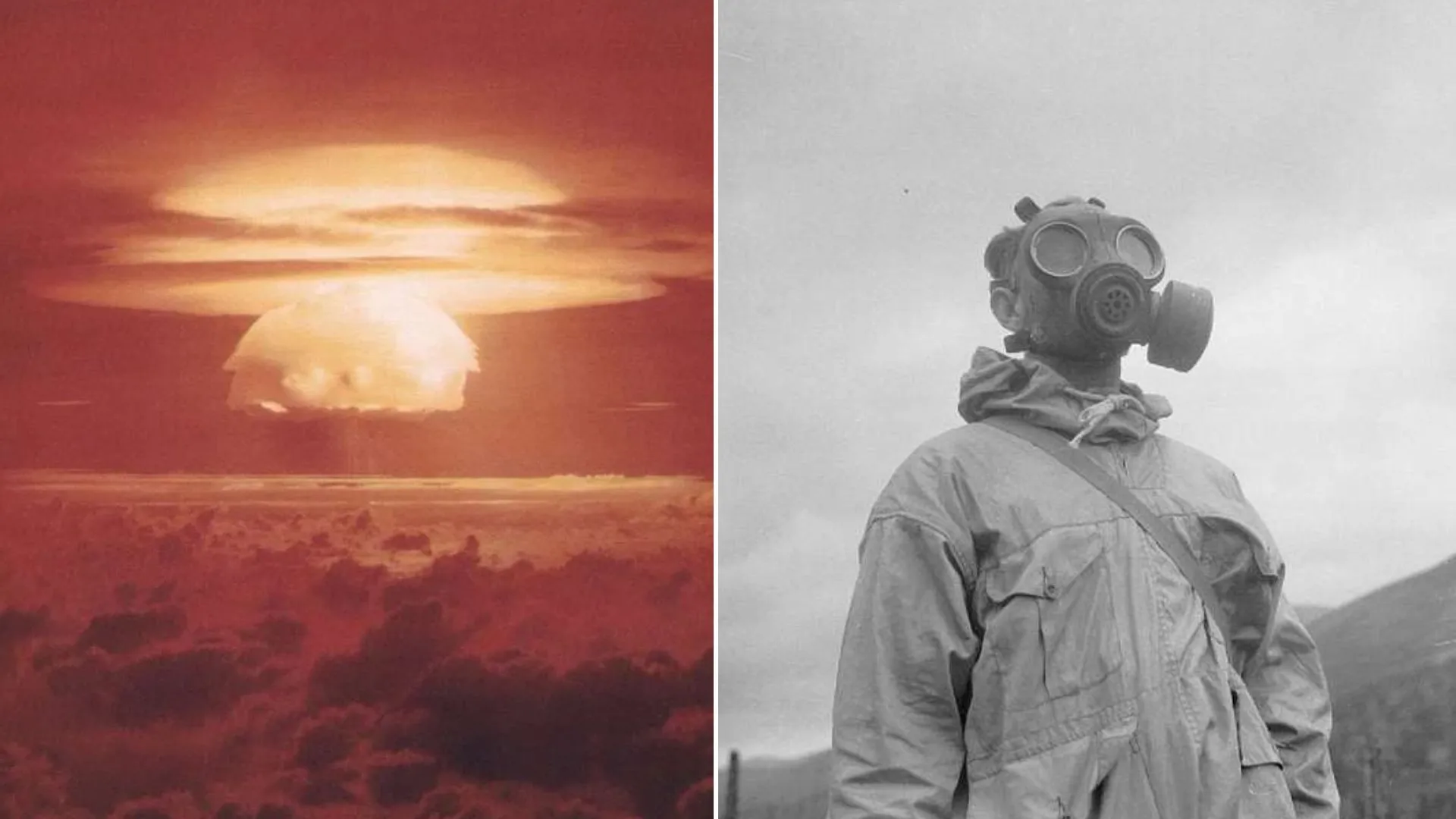
In an ideal world, there would be no wars and humanity would have little reason to develop weapons designed to destroy life on such a large scale. Unfortunately, conflict is a recurring part of human history and drives the development of increasingly destructive technologies.
From nuclear bombs that can destroy entire cities to chemical warfare agents and explosives that can threaten civilians long after fighting has ended, some weapons have impacts that extend far beyond the battlefield. Their impact is measured not only in immediate losses, but also in lasting environmental damage, displacement, disease and human suffering across generations.
There is no universally accepted ranking of the world’s deadliest weapons. But these seven stand out for their destructive potential and the devastating consequences they can have when used.
1. Nuclear weapons
Few weapons come close to the destructive power of an atomic bomb. A single detonation can produce an enormous explosion, intense heat and dangerous radiation, destroying buildings and overwhelming emergency services. The consequences can last for generations.
The most powerful atomic bomb ever detonated was the Soviet Union’s Tsar Bomb, tested over Novaya Zemlya on October 30, 1961. The estimated yield was 50 megatons of TNT, about 3,300 times the yield of the Hiroshima bomb.
This was a test device, not an operational weapon. But the threat today comes from the thousands of nuclear warheads located in countries around the world. The Stockholm International Peace Research Institute estimated that nine nuclear-armed states had about 12,241 warheads as of early 2025.
2. ICBMs
An intercontinental ballistic missile (ICBM) is a delivery system rather than a warhead. However, it makes nuclear weapons particularly dangerous because they can travel across continents.
ICBMs can carry nuclear warheads thousands of kilometers, with some designed to fire multiple independently targetable re-entry vehicles (MIRVs). This allows a missile to carry multiple warheads aimed at different targets.
The combination of long range, high speed and multiple warheads makes strategic missile systems the most consequential weapons ever developed. Their existence also carries the risk of rapid escalation during a crisis, particularly when warning times are short.
3. Biological weapons
Biological weapons transform microorganisms or toxins into instruments of war. These can be bacteria, viruses, or substances produced by living organisms and intentionally released to cause illness or death.
Anthrax, plague and botulinum toxin are among the biological agents of serious public health concern. Some biological threats are particularly difficult to contain because an infectious disease can spread beyond initial exposure and potentially cause an epidemic.
Unlike a traditional explosion, a biological attack may not be immediately detectable. The impact could occur over time and place enormous pressure on health systems and health authorities.
The Biological Weapons Convention, which came into force in 1975, prohibits the development, production, acquisition, transfer, stockpiling and use of biological and toxin weapons.
4. Chemical nerve agents
Chemical weapons use toxic substances to injure or kill. Among the most dangerous are neurotoxins such as sarin and VX, which impair the nervous system’s ability to regulate vital body functions.
These substances can cause severe symptoms such as seizures, paralysis and respiratory failure. VX is of particular concern because, depending on environmental conditions, it can remain dangerous on surfaces for extended periods of time.
Chemical weapons have been used in modern conflicts, including the Iran-Iraq War and the Syrian Civil War. Their impact can extend beyond the immediate losses, leaving lasting health problems among survivors and communities struggling to cope with the contamination.
The Chemical Weapons Convention prohibits the development, production, stockpiling and use of chemical weapons.
5. Thermobaric weapons
Thermobaric weapons are often referred to as fuel-air or vacuum bombs and are designed to generate intense heat and sustained explosive pressure. As part of their explosion process, they use oxygen from the surrounding air and thus create a strong pressure wave.
Their effects can be particularly destructive in enclosed spaces such as tunnels, bunkers and buildings, where pressure waves can be reflected from surrounding surfaces. Resulting injuries can include severe burns, internal trauma, and respiratory damage.
Russia’s TOS-1A heavy flamethrower system is a well-known thermobaric munitions platform. Despite the nickname, these systems are not traditional flamethrowers; They launch rockets with special warheads.
6. The GBU-43/B MOAB
The U.S. military’s GBU-43/B Massive Ordnance Air Blast, better known as the mother of all bombs, is among the largest conventional bombs ever developed.
Weighing approximately 21,000 pounds (9,525 kg), the GPS-guided weapon is designed to generate massive blast overpressure against large-scale targets and structures such as tunnels and cave complexes.
The MOAB was used in combat for the first time on April 13, 2017, when the United States dropped it on an ISIS-occupied cave complex in Afghanistan.
Despite its enormous size, it is not a nuclear weapon. Its destructive power is significantly less than that of even a relatively low-yield nuclear device, but it remains one of the most powerful conventional weapons in the U.S. arsenal.
7. Cluster munitions
Cluster munitions are used to distribute numerous smaller explosive devices, so-called submunitions, over a large area. They can be transported by aircraft, rockets or artillery systems.
Your danger doesn’t end when the first attack is over. Some submunitions do not explode on impact, turning fields, roads and residential areas into minefields that can remain dangerous for years.
Children and civilians returning to damaged communities are particularly at risk from unexploded ordnance. According to the International Committee of the Red Cross, at least 1,063 people were killed or injured by cluster munitions in 2025, with 87% of recorded victims being civilians.
The 2008 Convention on Cluster Munitions prohibits their use, production, stockpiling and transfer to contracting states.
The Destructive Legacy of Modern Warfare
The true price of these weapons cannot be measured solely by their explosive power or technological advances. Nuclear weapons can threaten entire populations, biological and chemical warfare agents can have lasting health consequences, and unexploded ammunition can claim the lives of civilians long after the war has ended.
Ideally, technological progress would aim to improve life rather than find new ways to destroy it. Until then, understanding the destructive potential of these weapons is also a reminder why preventing their use, limiting their spread and protecting civilians must remain a priority.
