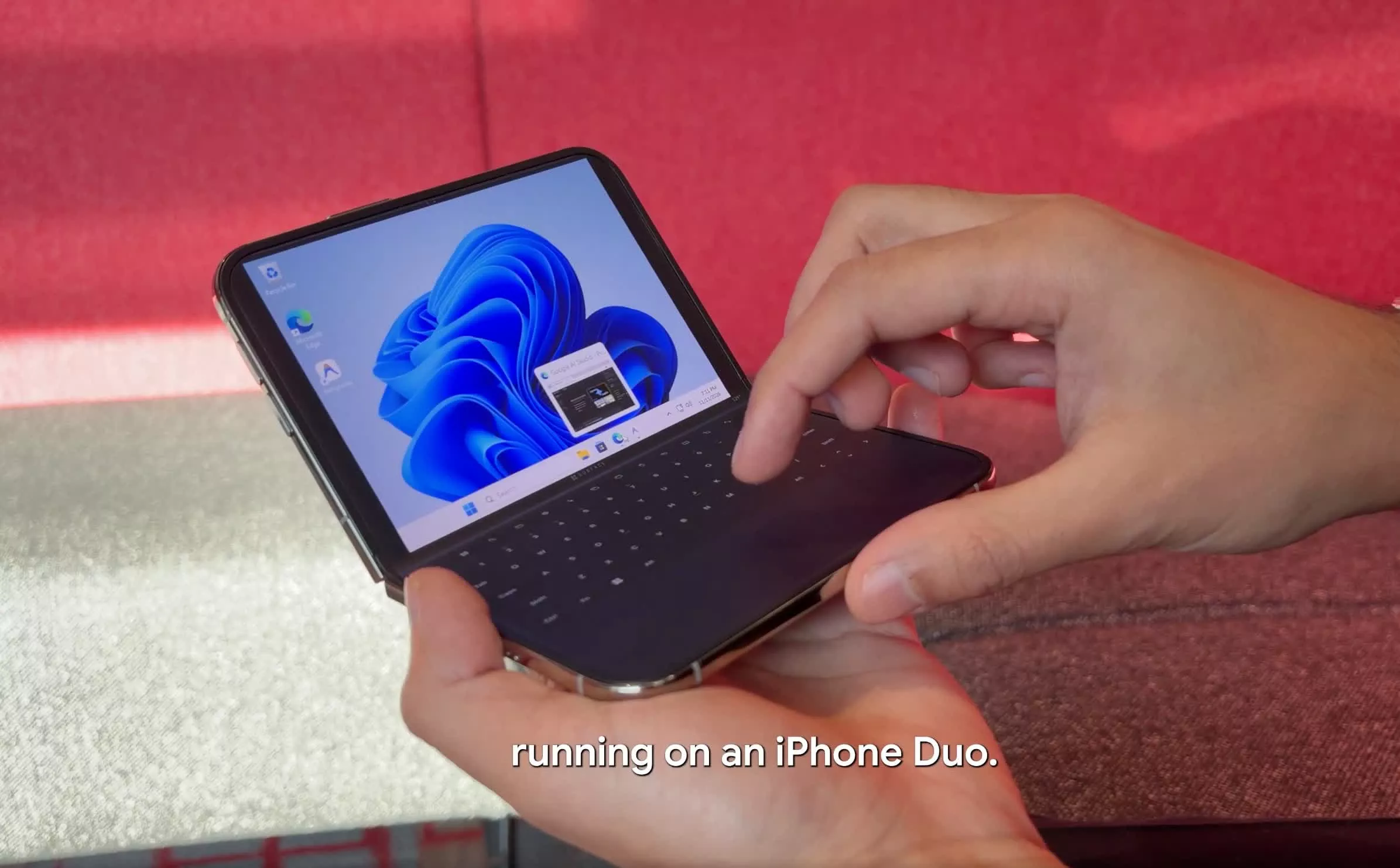
In context: Apple’s first foldable device has only been on sale for about three weeks and already runs Microsoft’s desktop operating system. A Google product lead has gotten the full Arm version of Windows 11 to boot locally on the iPhone Duo without jailbreaking the phone. Fold it in half and the bottom screen becomes the keyboard and trackpad. Flip it open and Windows takes over the entire 7.6-inch display.
The project, called WindowsiOS, comes from Ammaar Reshi, who is responsible for product and design at Google AI Studio. He posted a demo on X this week and also shared the full source code on GitHub. The demo shows a retail version of Windows 11 24H2 with Microsoft Edge and Google’s Antigravity coding app, all with touch controls.
Windows has technically run on an iPhone before. In 2024, the developer of Tiny11 launched a stripped-down build on an iPhone 15 Pro using the UTM SE emulator. However, it took about 20 minutes to reach the desktop, mainly because UTM SE has to interpret every instruction in the software.
– Ammaar Reshi (@ammaar) November 11, 2026
The faster route of hardware virtualization is also off the table, as Apple has blocked hypervisor access to standard iOS from iOS 16.4. Instead, WindowsiOS translates Windows’ Arm code into Arm code that the Duo’s A20 Pro chip can run directly. Both sides already use the same instruction set – the same edge that recently allowed Switch games to run natively on iPhones.
As for the build, the README file for the Gemini 4 Carbon project attributes all Windows-specific engineering. Google opened Carbon only to developers and AI Ultra subscribers this week, so the demo doubles as a handy showcase for it. Nevertheless, the core translator is not new. It comes from Henge, an open source project that has already made macOS work on modern iPhones.
However, don’t expect an entry in the App Store. Setup requires an Apple Silicon Mac with Xcode and your own Windows 11 Arm image. Each boot also requires a debugger to be connected to the phone to unlock the executable memory that the translator relies on. This is an unofficial workaround that JIT-hungry iPhone emulators also rely on, so Apple could turn it off in a future iOS update, similar to what happened with hypervisor access.
Windows also only gets 4.5GB of the Duo’s 12GB of RAM. To make this work, Reshi removed more than 35 background services from Windows, including Defender. This drops the idle memory usage to around 1.46 GB. However, the README file does not provide any benchmarks to back up the claims of near-native speed. Also, it has only been tested on the Duo so far.
Oddly enough, it’s not even the first duo crossover in recent weeks. As reported here, a developer got iOS 26 running on Microsoft’s Surface Duo 2 in late October. Next, he plans to push the iOS 27 build of the iPhone Duo to this phone.
