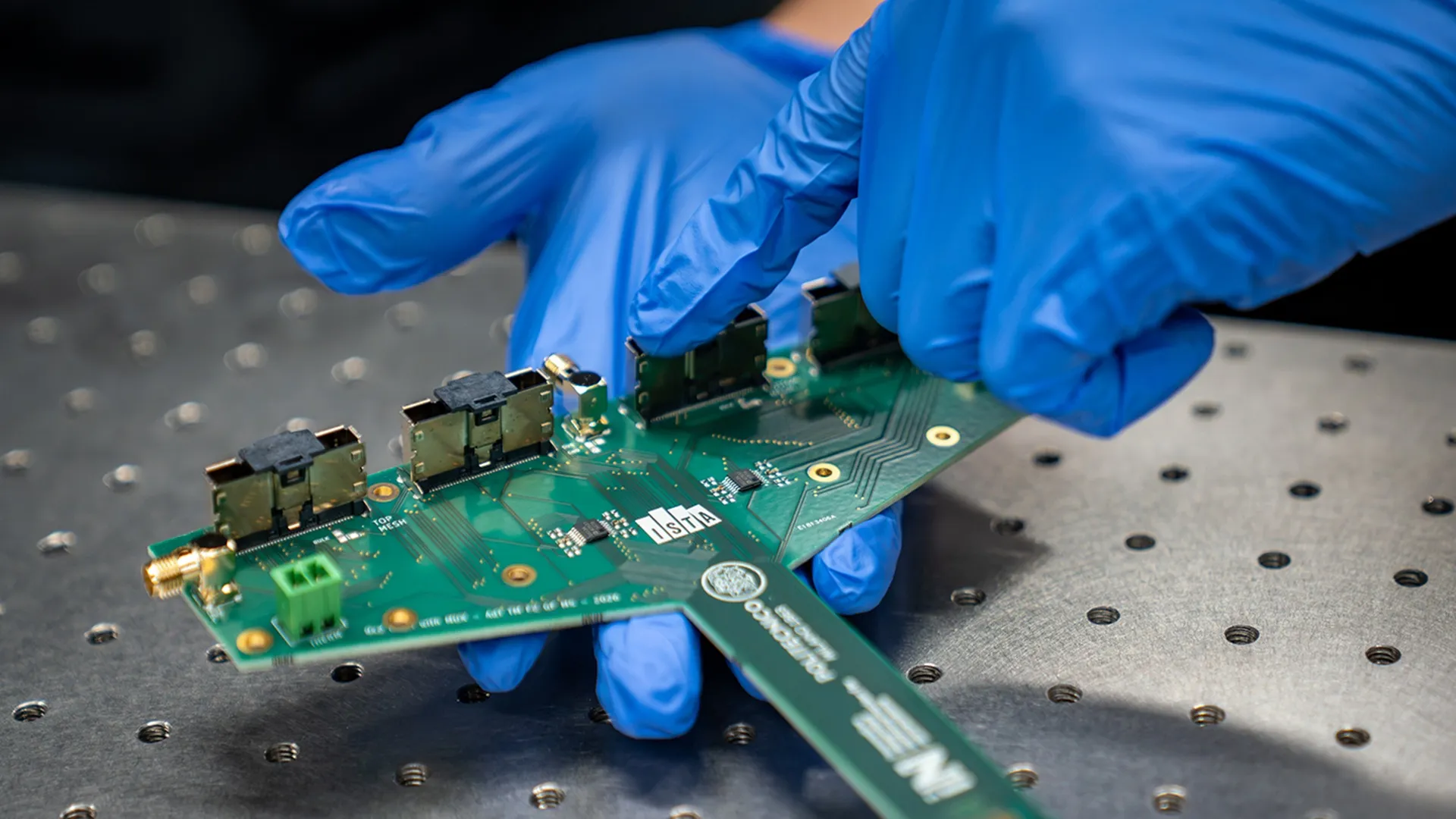
Researchers at Stanford University and collaborating institutions have developed a photonic chip that can split partially coherent light into different, mutually incoherent beams, potentially helping cameras, microscopes and telescopes capture information that traditional imaging might miss.
The fingernail-sized device uses a network of light-processing components and an optimization algorithm to identify and physically separate the underlying coherence modes within a mixed optical field.
The Advance, published October 30 in Nature photonicsdemonstrates a capability that researchers had theoretically proposed decades ago but had not previously achieved experimentally.
Most conventional optical systems are based on coherent light, such as laser beams, whose waves maintain a stable relationship to one another. In contrast, ordinary light sources produce light with varying degrees of coherence. When multiple contributions overlap, their combined intensity can obscure information about the underlying optical field.
The new photonic light analyzer could help recover some of this information by splitting the field into its different coherence modes.
Chip learns light patterns
The researchers built the device using a silicon photonic circuit that contained a network of interferometers. These components direct and manipulate light on a chip, similar to how electronic circuits process electrical signals.
The team fed two independent infrared lasers into the chip, creating a partially coherent mixture. The device used a self-configuring network and optimization algorithm to identify the predominant coherence modes in the incident light.
Instead of simply separating the original laser sources, the chip diagonalizes the coherence matrix of the light field. This creates orthogonal modes that are incoherent with each other, even if the original beams spatially overlap.
The researchers demonstrated the approach using a device with nine inputs. It separated the two strongest coherence modes with greater than 98 percent accuracy compared to a reference tomography method. In a separate three-mode experiment, they also confirmed that the system can work across two modes.
Once configured, the chip physically routes the separated modes to different output channels, where they remain available for further optical processing.
“Our chip learns the underlying coherence modes of an unknown light field and physically routes them into separate outputs,” said co-author Shanhui Fan, a professor of electrical engineering at Stanford.
Imaging reveals hidden information
The ability to distinguish overlapping optical contributions could improve measurements in situations where conventional cameras record similar-looking intensity patterns.
For example, two fluorescent particles that are close together may appear as a single feature under the microscope. Nevertheless, their light could contain different spatial and phase information. Separating the coherence modes could help reveal this distinction.
The researchers also showed that the chip can measure information contained in phase relationships that would be missed by pure intensity measurements.
The team is now working with NASA to investigate whether the approach could help analyze light from distant galaxies. For example, a single bright feature in a telescope image could contain light from multiple stars or other astronomical sources.
Beyond imaging, researchers say the technology could support optical sensing, communications and computing. The same chip architecture can also be operated in reverse to produce partially coherent light with a chosen coherence structure.
The work establishes a programmable approach to measuring, separating and controlling partially coherent light. Further development is required to scale the system to a greater number of optical modes and faster control speeds before it can be used in practical imaging systems.
The research was published in Nature photonics.
