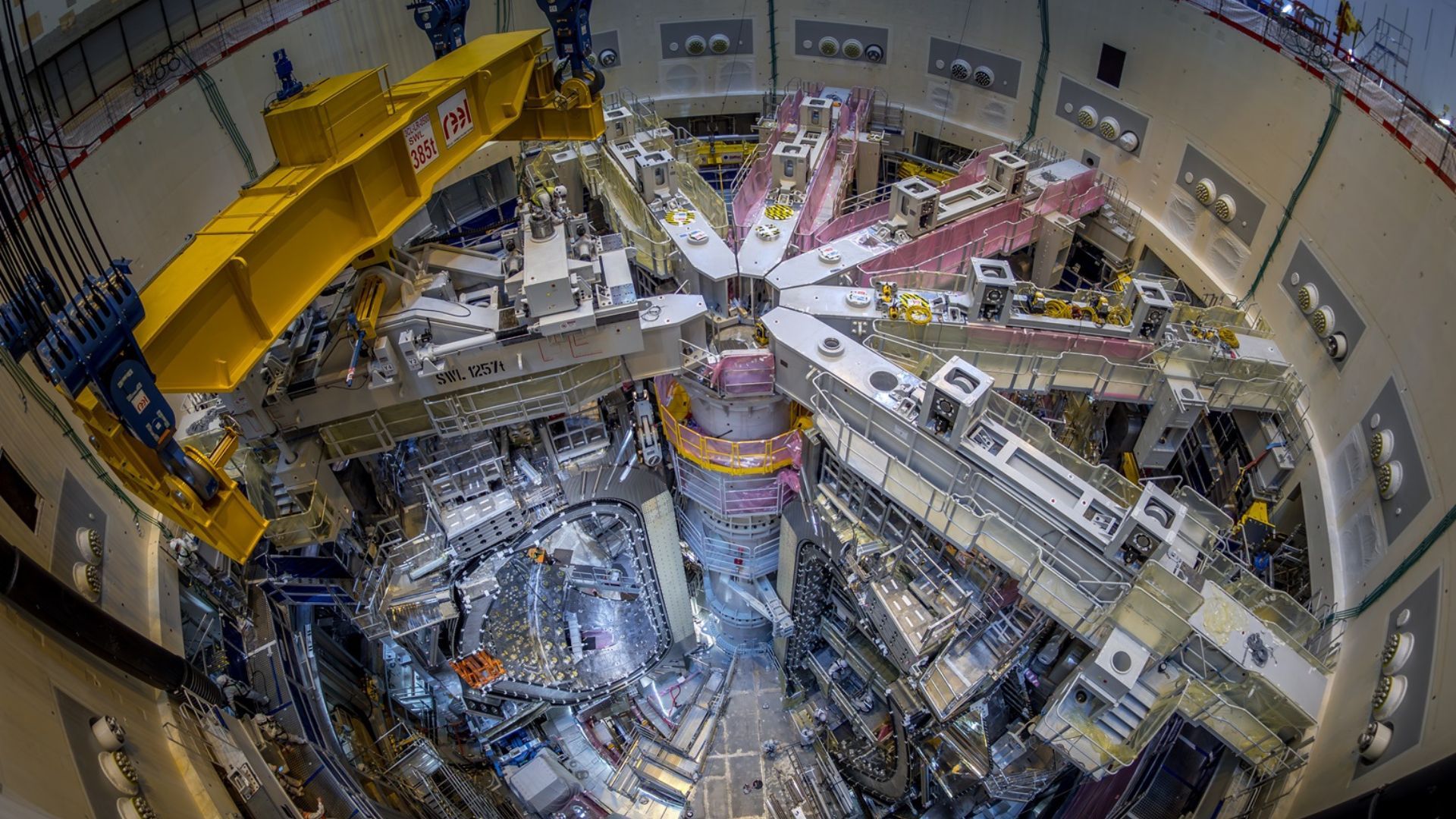
ITER has completed a major testing campaign on one of its 330-ton superconducting magnets, successfully charging the massive component to 34 kiloamperes (kA) before removing it from its magnet cold testing facility.
The D-shaped toroidal coil, designated No. 17, was cooled to 4 Kelvin (minus 269 degrees Celsius) and tested at half its rated operating current of 68 kA. The successful campaign allowed engineers to assess how the magnet deforms under electromagnetic stress and compare its behavior with structural models.
The coil was transferred from the facility to a transport frame on October 30th. It will now be taken to an interim storage facility before going to the ITER assembly hall, where it will be integrated into the last sector module of the plasma chamber.
The success provides valuable operational experience prior to commissioning ITER’s integrated magnet systems.
Superconducting coil passes tests
The Magnet Cold Test Facility is designed to evaluate ITER’s superconducting magnets and their supporting infrastructure prior to installation into the tokamak. This includes cryogenics, vacuum systems, power supplies, electrical supply lines and control systems.
The first test campaign began in May 2026 with ring field coil No. 7. The engineers cooled the magnet to 4 K and supplied it with 10 kA. This allowed them to assess the electrical resistance at its connections and evaluate the system responsible for detecting a loss of superconductivity, the so-called quench.
Testing of Coil No. 17 began in August. Reaching 34kA represented a significant increase in test current and allowed engineers to study the component’s structural response under stronger electromagnetic forces.
“It is an important step to reach 34 kA and confirm that the coil behaves as predicted by the models,” said Adrien Deydier, ITER’s lead mechanical engineer who was involved in the tests.
The campaign also provides operational experience to teams preparing for integrated commissioning, he added.
The next coil aims for full current
After coil #17 is removed, the magnetic cold test equipment prepares for toroidal coil #19, which was manufactured as a replacement. Cooling to 4K is scheduled to begin in April 2027, followed by testing at 34kA.
The next campaign will introduce Paschen-tight connections between the feed in the cryostat and the coil. These connections correspond to those planned for the tokamak and allow engineers to assess the magnet’s high-voltage ground insulation.
The system is then opened to install a reinforcing structure designed to prevent coil deformation when energized at its full operating current of 68 kA.
Engineers will also conduct temperature margin tests by selectively heating parts of the coil to trigger a loss of superconductivity. This will help verify the magnet’s operating margins and protection systems.
After testing coil #19, the facility will be reconfigured to accommodate poloid field coil #1, a ring-shaped magnet that forms another part of ITER’s magnetic confinement system.
ITER’s toroidal field magnets are essential for confining the superhot plasma in the reactor. The project will use 18 D-shaped toroidal field coils as well as six poloidal field coils and a central magnet to generate and control the magnetic fields required for fusion experiments.
The cold test program is intended to identify potential problems before the magnets are integrated into the machine, thereby reducing risks during commissioning and subsequent operation.
