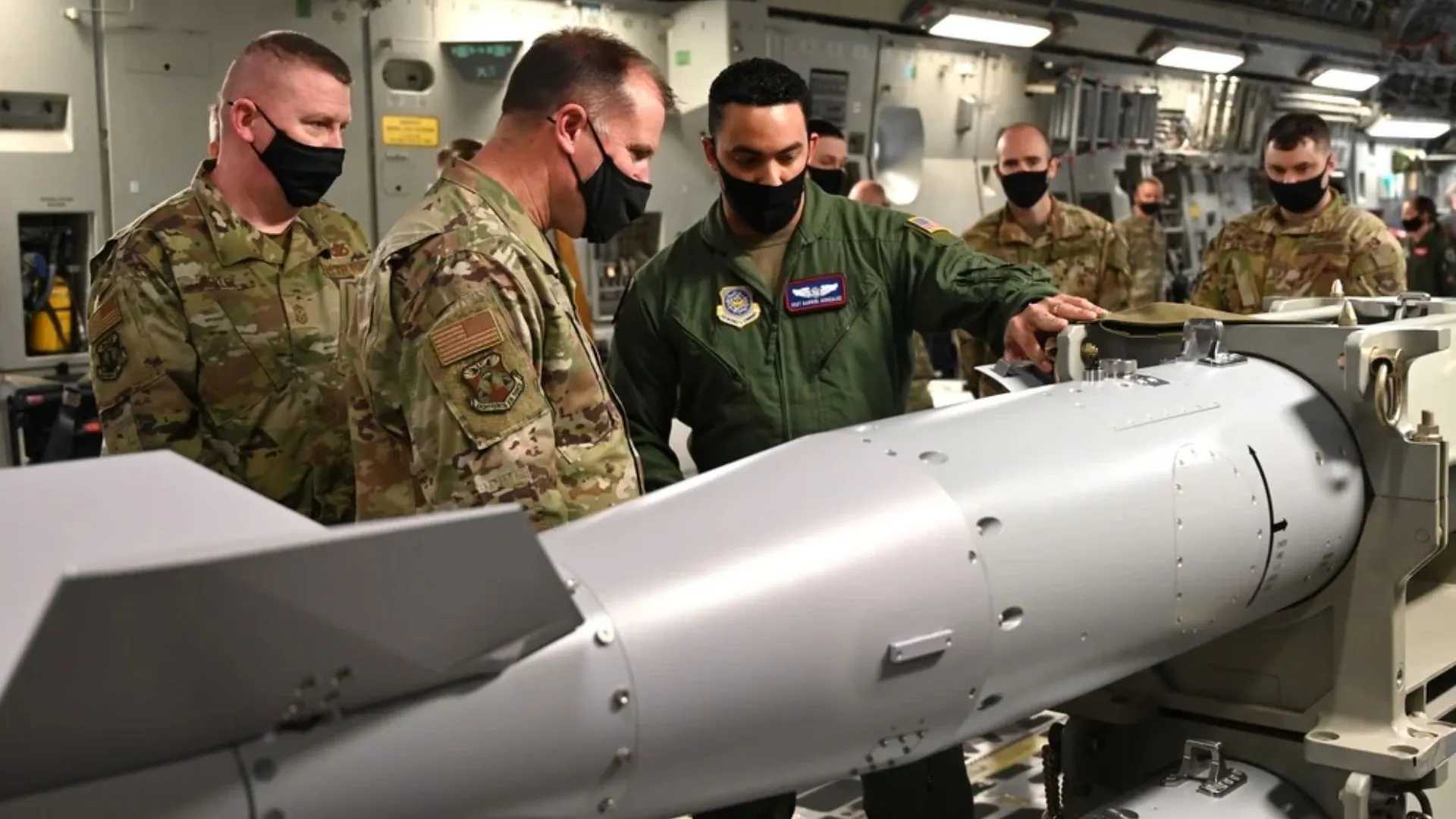
For the first time in more than three decades, a previously unpublished US nuclear bomb designation, B94, appears in federal budget documentation.
The line item is recommended for $77.108 million in initial funding for fiscal year 2027 and represents the first entirely new designation for an American aerial nuclear gravity bomb since the end of the Cold War.
In the U.S. Department of Defense and Energy’s alphanumeric naming system, a “B” prefix denotes an airborne gravity bomb launched from an aircraft, while a “W” prefix identifies a warhead mounted on a missile, torpedo, or artillery shell.
While the United States continued to modernize existing weapons, such as the B61-12 and the recently completed B61-13, these efforts retained the old family numbers. The last completely new bomb designation was the B90 nuclear depth and attack bomb, which was phased out in September 1991 as part of the post-Cold War arms reductions.
What the Senate budget bill reveals
The B94 entry appeared on page 143 of the 179-page explanatory memorandum to the Senate Energy and Water Development Committee’s fiscal year 2027 budget proposal released on November 12, 2026. The table is listed in the National Nuclear Security Administration (NNSA) Stockpile Modernization Account and recommends $77.108 million for the B94 versus a blank column for fiscal year 2026, confirming that it is a newly funded line item.
The file, first publicly viewed by nonproliferation researchers including Eliana Johns of the Federation of American Scientists and Jeffrey Lewis of Stanford University, does not contain an accompanying description explaining the weapon’s design, yield, carrier aircraft or deployment schedule. In the same budget table, funding for the old B61 life extension program drops to zero, while the newer B61-13 variant is pegged at $46.428 million.
Because the Senate bill still requires approval from the full chamber, reconciliation with the House of Representatives, and the President’s signature, the $77.108 million figure remains a committee recommendation and not enacted funding.
Possible connections to a new nuclear bunker buster
Although neither the Senate Committee nor the NNSA have officially defined which weapon carries the B94 designation, nuclear policy analysts point to the Nuclear Deterrent System – Air-delivered (NDS-A). The NDS-A has been in development since at least 2022 and is the only new air-dropped nuclear munition publicly acknowledged in the U.S. modernization pipeline.
In early 2026, the Department of Energy requested about $100 million to further develop the program, which NNSA said would provide additional options against “hard and deeply buried targets.”
The US stockpile currently consists of two aging gravity bombs for fortified underground facilities. The earth-penetrating B61-11, which has an estimated maximum yield of between 340 and 400 kilotons, and the megaton-class B83-1. While the newer B61-13 adds precision tail guidance to a higher-yield B61 physics package, it lacks the hardened housing required for deep earth penetration.
Analysts suspect the B94 could formalize the NDS-A program as a dedicated successor to the B61-11, the B83-1, or both, although officials have not ruled out a separate, unannounced gravity bomb.
More comprehensive modernization of nuclear energy
If the B94 initiative comes into force, it will be accompanied by a comprehensive overhaul of the entire US nuclear triad. In addition to air-dropped gravity bombs developed for stealth platforms such as the B-2 Spirit and the upcoming B-21 Raider, NNSA and the Pentagon are simultaneously developing the W93 submarine-launched warhead, the LGM-35A Sentinel ICBM, new nuclear-armed cruise missiles, and the Columbia-class ballistic missile submarine fleet.
