AI readiness requires more than selecting the right servers, storage and computing capacity.
These considerations are particularly important for financial institutions, where reliability, regulatory obligations and the need to demonstrate returns on technology investments influence deployment decisions. Meanwhile, according to John Scimone, president and chief security officer of Dell Technologies Inc., AI is changing the threat landscape, giving less sophisticated attackers access to capabilities that previously required significantly greater resources.
“I think the pyramid still exists, but undoubtedly the cost of entry and the barriers to entry have collapsed,” he told theCUBE. “In other words, tomorrow’s least sophisticated attack is more sophisticated than the world ever saw a year ago.”
Scimone spoke with Dave Vellante of theCUBE Research during the Dell Technologies New York Symposium, part of SiliconANGLE Media’s exclusive coverage of theCUBE. During the event, Dell executives and cloud infrastructure providers examined the economics of enterprise AI, the operational challenges of scaling infrastructure, and the decisions that shape AI adoption.
Here is theCUBE’s full video discussion with John Scimone:
Here are three takeaways you may have missed from theCUBE’s coverage of the Dell Technologies New York Symposium:
Insight #1: Enterprise AI requires a new operating and economic model.
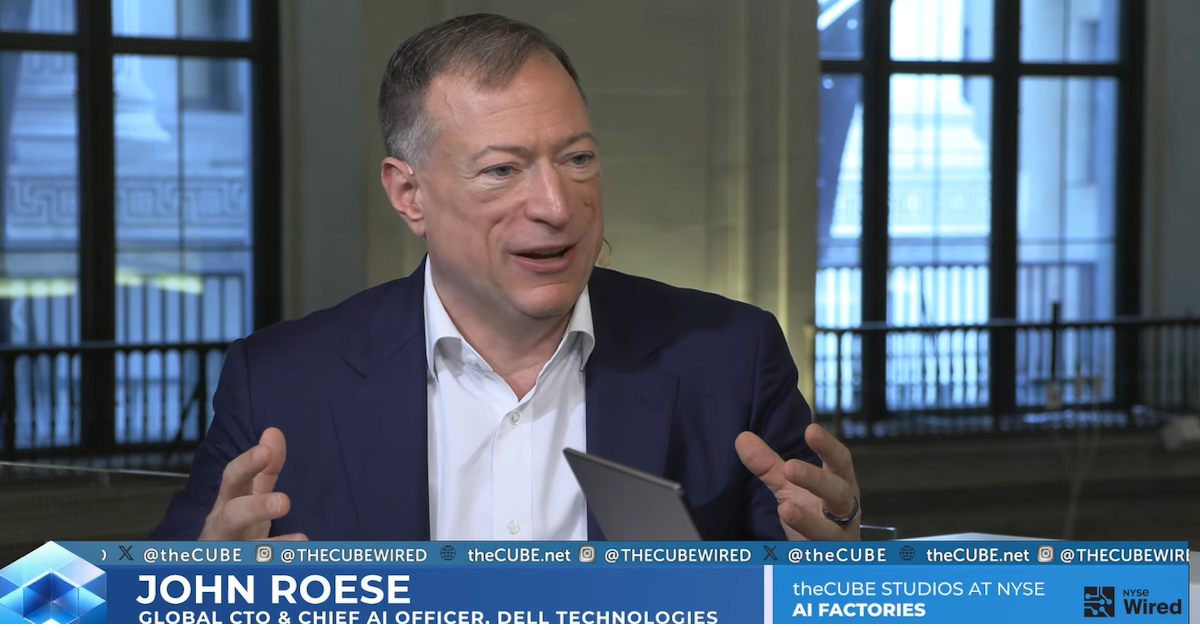
Dell has spent nearly two years running fully autonomous agents internally, capturing institutional knowledge in machine-readable skill files that guide their behavior. According to John Roese, Dell’s global chief technology officer and chief AI officer, the effort is part of a broader reorganization of work around AI agents.
“That doesn’t mean you can’t use boundary models and open models,” he said during the event. “It just means that when you’re designing your AI system, you have to recognize that your defense moat isn’t the actual tools. It’s not even the models. It’s the specialized knowledge that’s now manifesting itself in these new forms that really capture what you know and do differently than your competitors.”
Here is theCUBE’s full video discussion with John Roese:
The financial side of AI readiness presents a different challenge. As companies scale their deployments, finance teams establish dedicated budget lines for token consumption and evaluate which workloads can be run more economically on-premises. For example, repetitive financial processes can use open-weight models to convert variable token expenses into more predictable fixed costs, according to Dell CFO David Kennedy.
“It’s not necessarily about the quantity and cost of a token,” he told theCUBE. “It’s about the tokens you use. Can you handle them efficiently? If so, you will achieve great results.”
Here is theCUBE’s full video discussion with David Kennedy:
Insight #2: AI infrastructure decisions go beyond computing capacity.
The growth of AI inference is changing the way companies distribute workloads across cloud environments, data centers, and edge devices. Dell’s expanded agent AI portfolio reflects this shift, with solutions spanning desktop systems and data center infrastructure. According to Kyle Dufresne, senior vice president of sales at Dell, companies are evaluating where to run models based on performance, data control and cost.
“We’re seeing business owners say, ‘Oh my God, these inference costs are getting higher and higher. How can we reduce these costs without stifling innovation?'” he said during the event. “We’re finding that it’s happening within that continuum, but increasingly right at the very edge.”
Here is theCUBE’s full video discussion with Kyle Dufresne:
Another challenge is infrastructure availability. According to David Schmoock, senior vice president of global revenue operations at Dell, demand for AI servers has strained the supply of components ranging from memory and processors to rack-level cooling, networking and power equipment.
“We didn’t do that joint planning and now your project could have been delayed by 60, 90, 120 days, impacting both the cost and the business,” he told theCUBE. “I would say, bring us in sooner. Allow us to work with you. I think at the end of the day you get the optimal result.”
Here is theCUBE’s full video discussion with David Schmoock:
Insight #3: The readiness of AI extends to cloud providers.
AI readiness is also increasingly becoming a consideration for smaller companies that need access to GPU computing without the resources of large companies. According to Thomas Kato, founder and CEO of Comet Cloud, Comet Cloud Inc. is targeting this underserved market where access to AI infrastructure can be limited by purchasing commitments and vendor priorities.
“You go to [Amazon Web Services] Now; They want a multi-year contract from you. “They choose who they take,” he said during the event. “It is not enough for small and medium-sized companies to have this AI at their disposal.” That’s really our focus.”
Comet Cloud is developing an alternative approach designed to give smaller companies greater control over their computing environments, Kato said.
“What we do is we put clusters together and we give clusters to an entire company. All of their information, all of their security, everything is within that cluster. There’s no one else tied or connected to it,” he told theCUBE.
Here is theCUBE’s full video discussion with Thomas Kato:
Alpha Compute Corp. also builds its Neocloud infrastructure around data sovereignty and confidential data processing requirements. According to Tom Richer, executive vice president of Alpha Compute, the company’s sovereign-by-design approach is intended to help customers maintain control of sensitive workloads and comply with data residency requirements, including those related to European regulations.
“We start with the hardware. Imagine a stack. All the way down to the chip level, we create enclaves,” he told theCUBE. “We are a Dell partner and therefore use both Dell technology and Intel technology.”
Maintaining GPU infrastructure presents a different challenge for Neocloud providers. Alpha Compute offers built-in infrastructure support and ongoing managed services to meet these needs, said Richer.
“You can put together a lot of different vendors, but when something goes wrong, the blame game starts,” he said during the event. “You just want an integrated solution provider to ensure your success, to help you with the whole build and then with all the…managed services so that everything runs smoothly and the performance is right.” [service-level agreements].”
Here is theCUBE’s full video discussion with Tom Richer:
To see more of theCUBE’s coverage of the Dell Technologies New York Symposium, check out our full video playlist here:
https://www.youtube.com/watch?v=videoseries
(*Disclosure: TheCUBE is a paid media partner for the Dell Technologies New York Symposium. Neither Dell, the sponsor of theCUBE’s event coverage, nor other sponsors have editorial control over theCUBE or SiliconANGLE content.)
Photo: SiliconANGLE
Support our mission to keep content open and free by interacting with theCUBE community. Join theCUBE Alumni Trust Networkwhere technology leaders connect, share information and create opportunities.
- Over 15 million viewers of theCUBE videosto spark conversations about AI, cloud, cybersecurity and more
- Over 11.4k theCUBE alumni — Connect with more than 11,400 technology and business leaders shaping the future through a unique, trusted network
Founded by tech visionaries John Furrier and Dave Vellante, SiliconANGLE Media has built a dynamic ecosystem of industry-leading digital media brands, reaching over 15 million elite tech professionals. Our new proprietary theCUBE AI Video Cloud is a game-changer in audience engagement, leveraging the theCUBEai.com neural network to help technology companies make data-driven decisions and stay at the forefront of the industry conversation.
