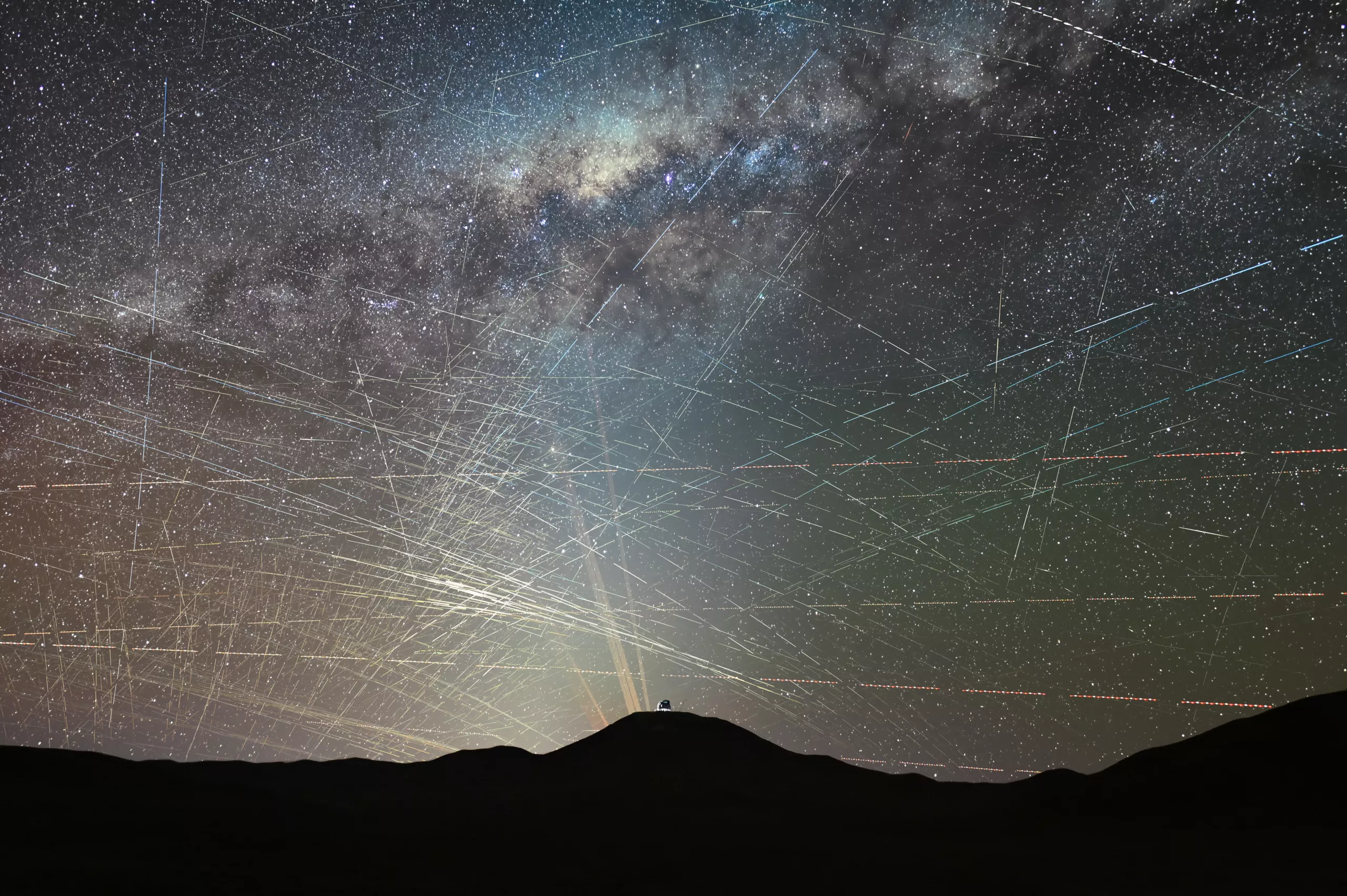
The big picture: Light pollution has already reduced the night sky over most major cities to a few dozen stars – perhaps a few hundred in the suburbs. Well, something else up there outnumbers them. At any given time after dark, there are about 710 satellites above the horizon over a typical city, according to a new analysis.
These figures come from the “Night Sky Report” published by British engineering firm Accu Components based on US Space Force tracking data from CelesTrak.
The company recorded where nearly 15,900 active satellites were in low Earth orbit every two minutes over seven October nights. It turns out that almost 13,000 different satellites fly over an average British city over the course of a whole night.
However, most of them cannot actually be seen. Satellites have no light of their own and are therefore only displayed as long as sunlight is still falling on them and the ground below is dark. According to the report, that number is around 105 at any given time – still more than the handful of stars that most city dwellers can see.
This average also hides a large variation throughout the night. A company spokesman told Space.com that about 300 satellites capture the light in the first hour after dark. At midnight, fewer than 20 are still lit.
Strangely, latitude acts in opposite directions on both sides of the Atlantic. In the UK, satellite numbers become thinner the further north you go, so Lerwick in Shetland sees just 47 satellites high in the sky – more than 30 degrees high – compared to 83 in Falmouth. Across the United States it is the other way around. Seattle tops the list with 88. Miami, on the other hand, is at the bottom with 57.
That depends on how Starlink’s orbits are designed. Its satellites are grouped around 43rd and 53rd degrees north. Since most of the U.S. lies south of these bands, you’ll get closer to them as you head north. But most of the UK is already at the 53 degree mark or above, so heading further north will just get you away from the crowd.
In fact, Starlink alone accounts for 70% of active satellites in low Earth orbit. SpaceX has also asked for permission to launch up to a million more satellites that would act as orbital data centers.
Admittedly, the report has not been peer-reviewed. It only covers October, so the number of insolation changes as the length of the night changes throughout the year.
Astronomers, on the other hand, are particularly worried about the upcoming satellites. In a study published this year, Olivier Hainaut, an astronomer at the European Southern Observatory, estimated that SpaceX’s planned constellation would make hundreds of satellites visible for much of each night – up to several thousand at certain times.
All of this is on top of light pollution from the ground, which already makes the night sky about 10% brighter each year.
