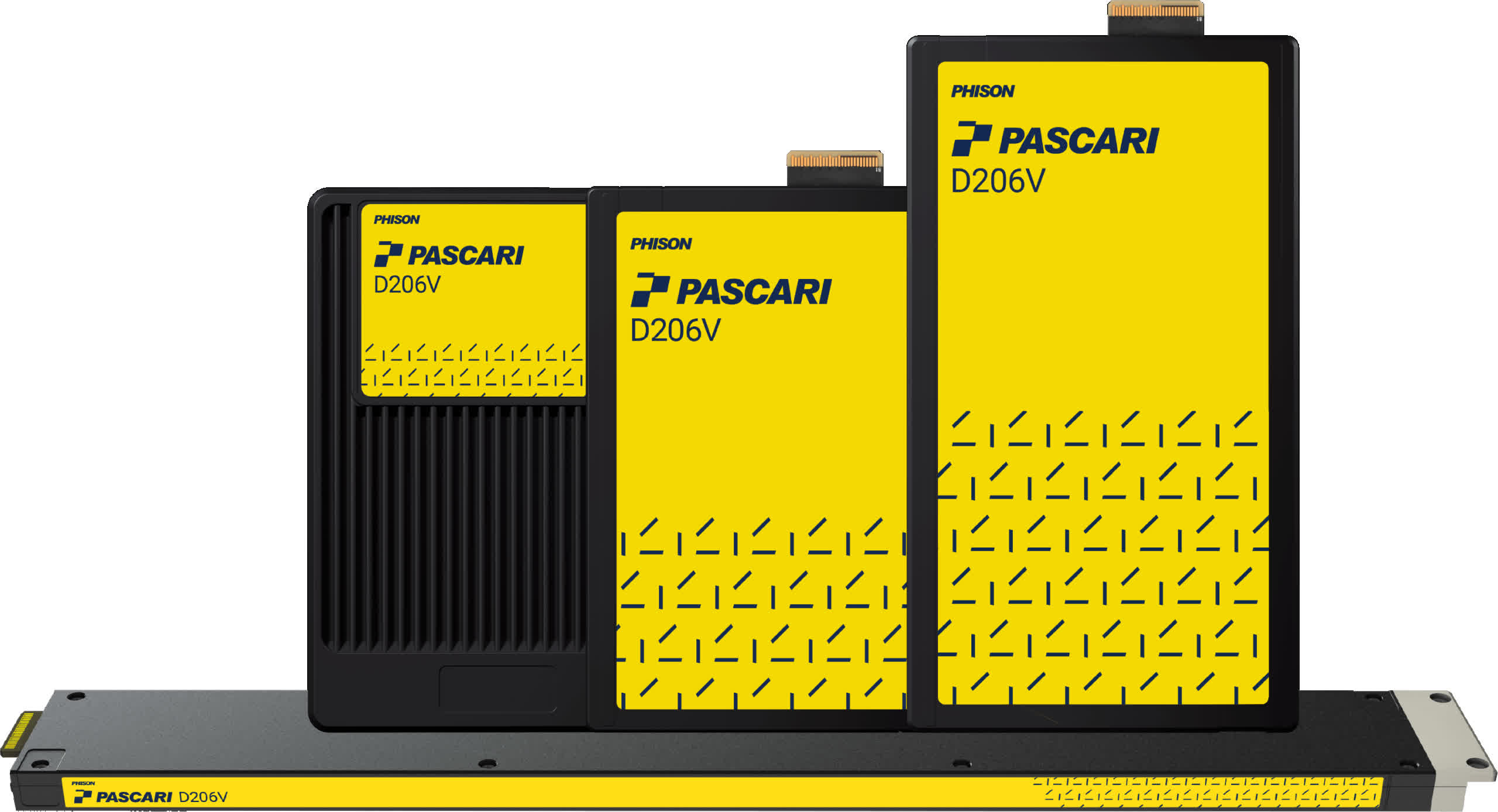
Future-oriented: Much of what AI servers do throughout the day is fetching data from their SSDs so that a CPU or GPU can process it. Phison wants some of this processing to happen before the data leaves the drive. The controller maker has detailed an SSD design with its own NPU and 64GB of memory, designed to run PyTorch and llama.cpp directly on the drive.
The company unveiled the design this week at Supercomputing 2026 (SC26) in Chicago. Instead of sending entire data sets to the host, the drive scans and processes the data in parallel right where it is located. It then only returns the results that matter. Phison claims that this could reduce data transfers by 10 to 100 times for suitable workloads. The host CPU would also get some breathing room.
On paper, the drive’s memory delivers a bandwidth of 130 GB/s. That’s more than four times the 28GB/s that Phison’s upcoming PCIe 6.0 controller can deliver to a host. In other words, the drive can read its own data much faster than it can transmit it to the server. The company also says developers don’t need any special programming tools as the drive supports well-known frameworks like vLLM and OpenVINO.
Strangely, the only computing number Phison shared for the NPU is 36,800 DMIPS. This is a decades-old CPU integer benchmark. As Tom’s Hardware points out, the number likely describes the companion CPU cores on the drive and not its AI processing power. There is no TOPS rating anywhere in the announcement.
The drive also doesn’t have a product name or sampling date yet. Phison didn’t even say what kind of storage it uses. In fact, the company states that many of the products and features presented are still in development. So at the moment it’s more of an architectural proposal than something a data center can actually order.
Drives that perform calculations are also nothing new. Samsung built an FPGA on its SmartSSD in 2018 and followed with a second generation in 2022. But TechRadar reported last year that the drive had all but disappeared from Samsung’s lineup. The company partly blamed the boom in generative AI for the fact that the demand for pure storage capacity is significantly greater than for on-drive processing.
Samsung’s drive also relied on software and IP that customers had to develop themselves. That makes Phison’s promise to support the AI tools developers already use make a significant difference. This could give the idea a better chance, assuming the NPU proves to be as capable as Phison claims.
