President Donald Trump today tapped Director of National Intelligence Jay Clayton to lead a new federal artificial intelligence task force, making him the administration’s second AI czar.
Trump revealed the group in a Truth Social post, calling it the Super Intelligence Force. That name refers to an executive order he signed last week directing federal agencies to use “superintelligence” instead of “artificial intelligence” in official correspondence.
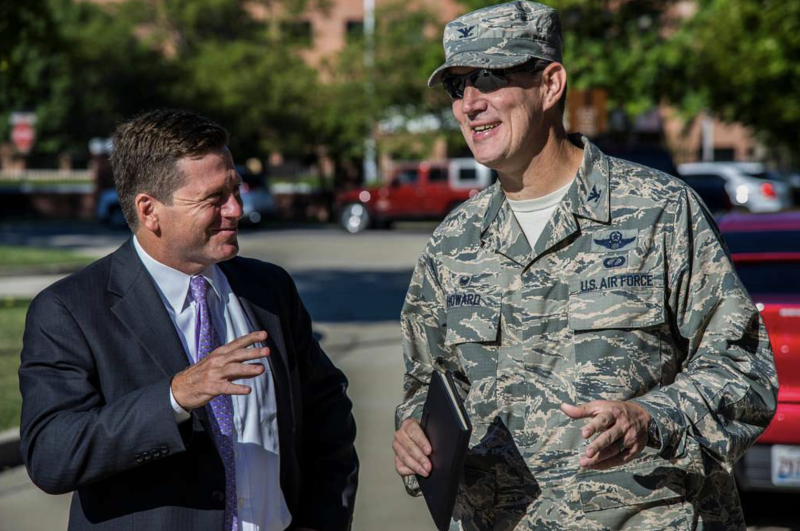
According to the post, there is power to “ensure America continues to lead the world in superintelligence.” Clayton (pictured left) told the Wall Street Journal that a report on the technology’s risks and opportunities is due within 120 days.
The report also looks at how the government handles the disclosure of security breaches and makes recommendations on how authorities can better respond within their existing powers. According to its charter, the group must “develop plans to respond to SI-related threats to our society while preventing over-regulation and regulatory capture that would stifle innovation and competition.”
Andrew Ferguson, chairman of the Federal Trade Commission, is one of three vice chairmen, along with Scott Kupor, director of the Office of Personnel Management, and Emil Michael, the Pentagon’s chief technology officer. The Journal reported that Vice President JD Vance, Defense Secretary Pete Hegseth and Treasury Secretary Scott Bessent will also be in office. Former Secretary of State Condoleezza Rice is expected to advise from outside the government, as is David Sacks, the venture capitalist who held the post of AI czar until March. The task force reports to Trump and White House Chief of Staff Susie Wiles.
In a recent CNBC interview, Clayton called the superintelligence community a national security problem and told the Journal that “the risk of not being first is high.” The idea of a coordinated slowdown came last month from Anthropic PBC chief Dario Amodei, who argued that new models need more time to be properly assessed. Support followed from Sam Altman and Elon Musk. Clayton rejected that approach in the same CNBC interview. “I don’t think any American should think that’s a good strategy,” he said.
The Senate confirmed Clayton as director of national intelligence in July. During Trump’s first term, he led the Securities and Exchange Commission and later served as U.S. attorney for the Southern District of New York.
Trump debuted an “AI military force” and a new czar in a Truth Social post on September 19, in which he called fears about the technology’s dangers a “hoax.” Ten days later, six technology leaders, including Amodei and Nvidia Corp. chief Jensen Huang, signed a voluntary security agreement at the White House on the same day Trump issued the renaming order.
The one-page document commits signatories to “four levels of controls and audits” and requires each lab to establish an independent board committee to oversee safety work. Asked whether the agreement was binding, Trump said: “I think it is morally binding.”
Photo: NARA and DVID Public Domain Archives
Support our mission to keep content open and free by interacting with theCUBE community. Join theCUBE Alumni Trust Networkwhere technology leaders connect, share information and create opportunities.
- Over 15 million viewers of theCUBE videosto spark conversations about AI, cloud, cybersecurity and more
- Over 11.4k theCUBE alumni — Connect with more than 11,400 technology and business leaders shaping the future through a unique, trusted network
Founded by tech visionaries John Furrier and Dave Vellante, SiliconANGLE Media has built a dynamic ecosystem of industry-leading digital media brands, reaching over 15 million elite tech professionals. Our new proprietary theCUBE AI Video Cloud is a game-changer in audience engagement, leveraging the theCUBEai.com neural network to help technology companies make data-driven decisions and stay at the forefront of the industry conversation.