Even when a nuclear reactor goes dark, it isn’t actually sleeping. The chain reaction stops immediately, but a thermal residue remains. Scientists call it decay heat. Left unchecked, this sustained energy can warp steel, melt components and turn a routine shutdown into a crisis.
Now researchers at the U.S. Department of Energy’s Argonne National Laboratory are proving that we don’t need electricity or human intervention to keep this under control. What is required, however, are simply the simple, unyielding laws of physics.
In a series of tests, engineers determined the behavior of a passive safety structure called the Reactor Cavity Cooling System (RCCS) in real time during large fluctuations in heat levels.
“Most advanced reactor suppliers rely on passive systems like RCCS to prove that their designs remain safe even in unlikely accident scenarios,” said Qiuping Lu, Argonne nuclear engineer. “Our experiments give them the high-quality data they need to show regulators that their security systems are working as expected.”
Cooling without a pump
Even after a nuclear reactor is shut down, residual decay heat continues to radiate from the core and requires reliable, continuous cooling. ANL researchers studied the RCCS, a passive setup that circulates water through surrounding metal pipes using natural buoyancy and gravity instead of mechanical pumps.
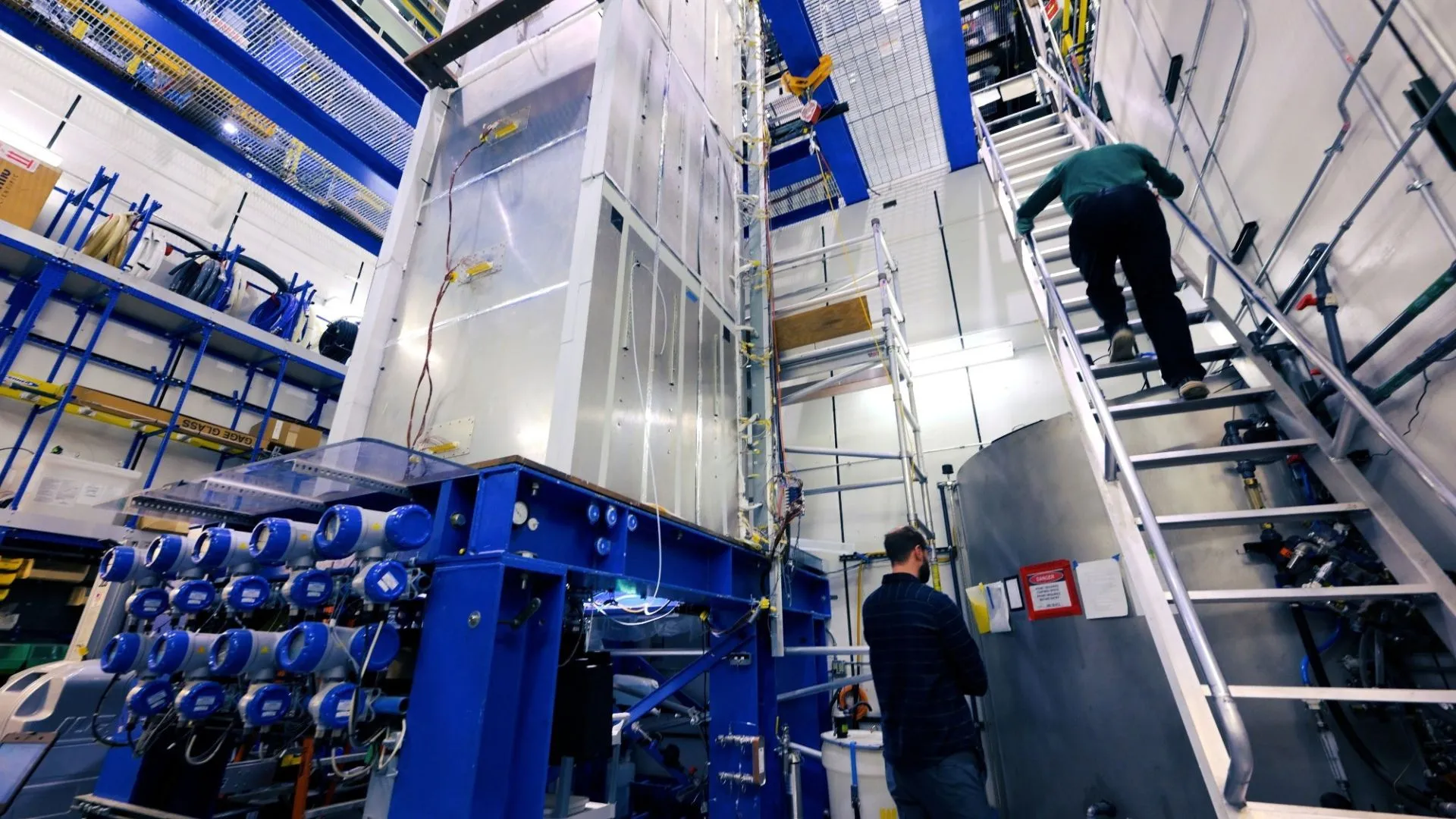
Warmer water rises toward an elevated storage tank while cooler fluid descends, dissipating heat without human or electrical intervention. This design was tested in the 59-foot-long Natural Convection Shutdown Heat Removal Test Facility, demonstrating how liquid water and steam interact during realistic power shifts. It provided important data on system performance under boiling conditions.
Argonne researchers simulated these real-world fluctuations in the NSTF plant through controlled testing over a range of scaled performance levels. They also adjusted the height of the main water tank inlet, a key design variable that determines overall water availability and alters natural circulation patterns throughout the cooling circuit.
“We asked two questions,” Lu said. “What happens if the decay heat is higher or lower than the designers expected? And does the reliability of the system change if you move the tank connection up or down?”
Lower heat delays dangerous surges
During several hours of power increases in the 59-foot-long NSTF test loop, researchers monitored how water heated, boiled and produced steam under simulated reactor conditions. And focused on “flashing,” a phenomenon in which rising water suddenly evaporates into steam due to falling pressure rather than additional heat.
These sudden bursts of steam result in flow surges and pressure fluctuations that reduce cooling efficiency and stress reactor components. This leads to the need to determine exactly where these instabilities arise, peak and dissipate.
The results provided two insights for designing the next generation of nuclear energy. At a full equivalent power of 2.4 megawatts, steam from flashing was flowing into the top chimney just 20 minutes after cooking began. Reduce that power to 1.75 megawatts, and the steam lasted 90 minutes. At 1.4 megawatts, the steam never reached the chimney.
The placement of the tank inlet also had a major impact on overall stability. Mid-altitude inlets stabilized quickly within 15 minutes, while lower-altitude inlets resulted in continuous flashing-induced instability throughout the test.
It turns out that a few feet of pipe alignment can make the difference between chaotic fluid flows and smooth, self-correcting cooling.
These results provide the concrete evidence needed to meet stringent nuclear regulations and optimize the global deployment of safer, melt-proof clean energy systems.