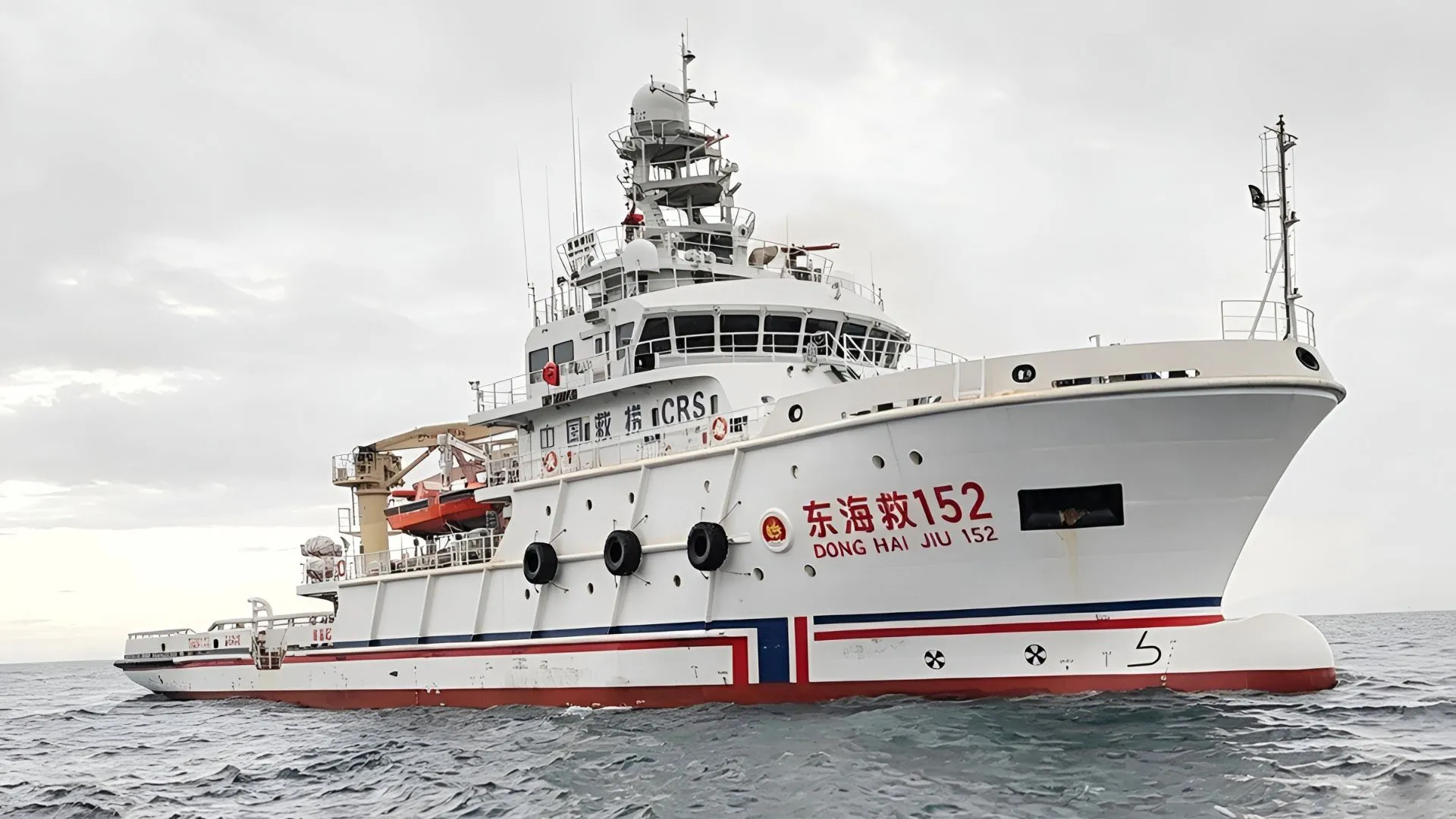
China has completed its first series of five domestically developed medium-sized sea rescue vessels, strengthening its ability to respond to emergencies along its coast. The last ship, Donghai Jiu 152, officially joined the Donghai Rescue Bureau of the Ministry of Transportation on November 13, 2026.
The 4,000-kilowatt vessel brings several specialized capabilities to China’s eastern coastal waters. Its propulsion and positioning systems enable crews to operate in difficult sea conditions. The ship can also support rescue operations with large numbers of survivors.
The delivery marks the completion of a nearly seven-year procurement program. China delivered the first ship, Donghai Jiu 151, in December 2019.
Designed for coastal emergencies
With a length of 69.5 meters (228 feet) and a width of 14.6 meters (48 feet), the Donghai Jiu 152 is aimed at rescue missions in China’s eastern waters. Its hull and onboard systems are suitable for demanding conditions on exposed coasts.
The ship can withstand strong winds and has an external fire extinguishing system. The capacity is also sufficient to accommodate up to 100 rescued people. This capacity provides rescue workers with additional flexibility during major emergencies at sea.
Its equipment also supports operations that go beyond traditional search and rescue operations. An advanced azimuth electric propulsion system ensures precise maneuverability. This configuration helps the ship navigate confined waters and maintain control during demanding missions.
A class 2 dynamic positioning system (DP-2) further expands its application possibilities. The system helps the ship maintain a specific position without relying entirely on conventional anchoring. This technology proves particularly useful when crews conduct operations near islands, reefs or other difficult coastal terrain.
Electric drive improves control
Dynamic positioning plays an important role in modern offshore and maritime operations. DP-2 systems use computerized controls to coordinate propulsion and maintain a ship’s position. They can balance out external forces such as wind, waves and currents.
Donghai Jiu 152 also has a three-point anchor device. Captain He Feng said the system helps the ship remain stable in shallow water. It can maintain this position in sea state 3 conditions CCTV News.
This capability supports diving operations that require a relatively stable work platform. Maintaining position in shallow water can prove difficult when currents and changing weather affect a vessel. The additional anchoring arrangement provides the crew with another option to manage these conditions.
Seven-year construction program
China began receiving the first ship in this series in December 2019. The Donghai Rescue Bureau received the Donghai Jiu 151 on December 25 of the same year. The ship laid the foundation for four other ships.
In December 2022, China State Shipbuilding Corporation (CSSC) signed contracts for four additional ships. The shipbuilder developed the new designs based on Donghai Jiu 151.
Subsequent ships also featured upgrades to digital systems and network connectivity. These improvements aim to support better coordination in sea rescue operations.
Completion of the five-ship program provides Chinese rescue authorities with additional coverage in near-shore waters. The broader emergency response network combines ships of varying sizes with sea, land and air assets. Together, these resources help authorities coordinate operations across different distances and rescue scenarios.
The new fleet also fills a gap in China’s coastal emergency response capabilities. Its medium-sized vessels can handle missions that may require more capacity than smaller lifeboats can provide. Their specialized equipment also enables crews to handle operations in demanding coastal environments.
