The contact center has been the low-hanging fruit of the artificial intelligence industry. Ask any IT or business leader what they want to use agent AI for and they’ll say it’s about improving the customer experience, which starts with the contact center.
However, the industry has been arguing for two years about which AI agent is the most intelligent. This is the wrong debate. Modeling capabilities are improving so quickly and becoming so much cheaper that pure intelligence and reasoning become the least differentiated part of the stack.
The real challenge for companies is to reliably operate a fleet of AI agents across the entire customer journey while maintaining the visibility and control that a large enterprise requires. Without this, the human, or worse, the customer, is left alone to connect the results of the growing number of agents with whom they communicate.
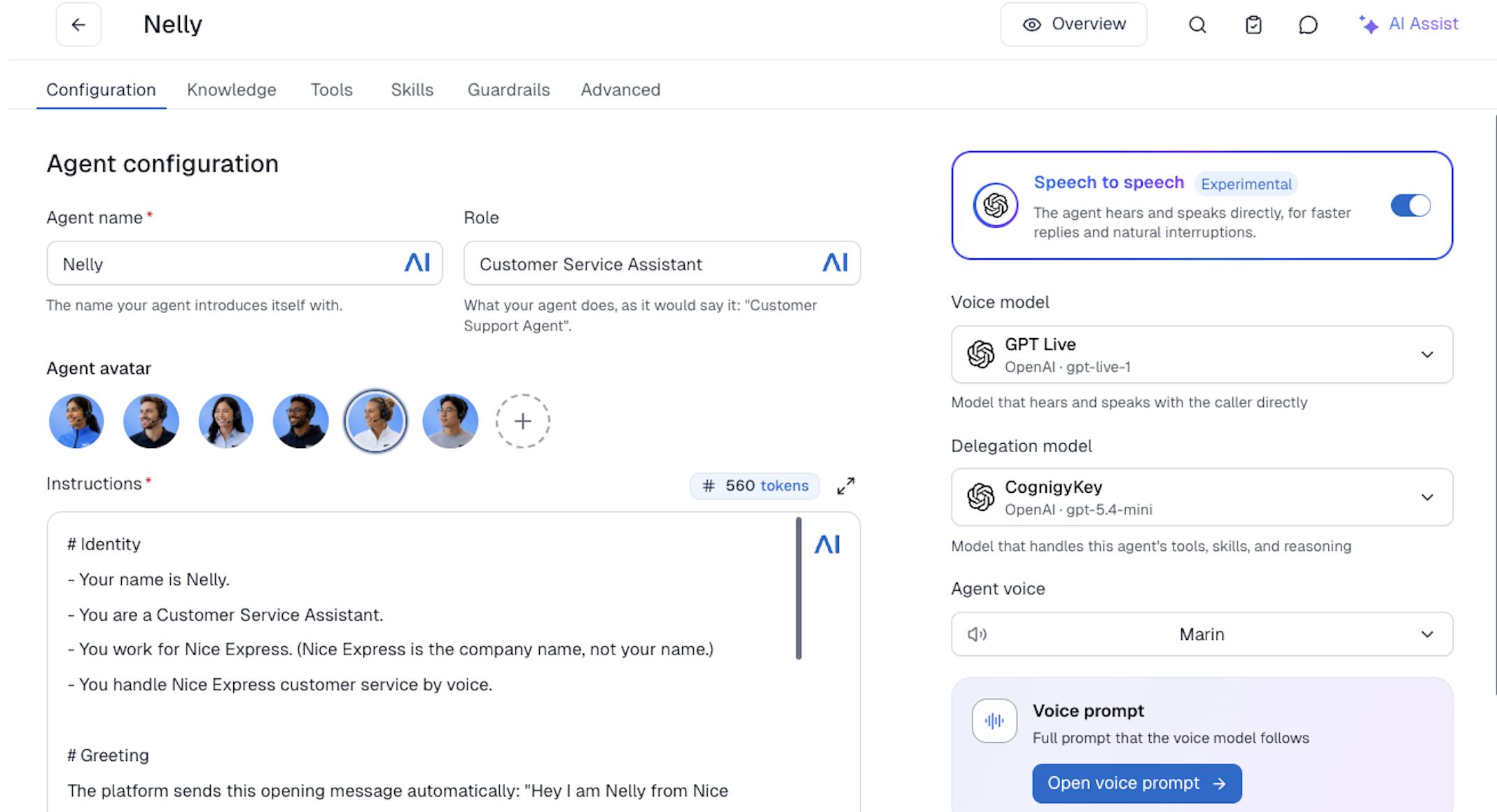
That’s the thesis behind the next generation of NiCE Cognigywhich NiCE Ltd. was founded this week. The release includes a redesigned Agentic Experience Studio, an AI Assist companion that covers agent building, testing, and improvement, reusable “skills” that bundle instructions and tools, turn-by-turn tracking, and native voice-to-voice model support.
Standard Speech-to-Text, Text-to-Speech, and Major Language models are now included in the per-call price. Premium models from Deepgram, ElevenLabs and Anthropic are available with just a few clicks and are billed based on usage.
Before the launch, I attended an analyst briefing with Nhu Ho, Senior Product Marketing Manager at NiCE Cognigy, and Clement Boutier, Director of Product Management, who leads the team that created the release and owns the platform roadmap.
Here are the key points from this press release:
Capable is not the same as reliable
Ho opened with a diagram showing how long the AI can work independently before a human needs to intervene. In 2020 it was just seconds; in 2024 it was minutes; and this year it’s about 16 hours. The footnote was interesting because this number was calculated with a 50% success rate. “Capable and reliable don’t always mean the same thing,” said Ho. “That’s where the platform matters.”
For CX leaders, this is a solid benchmark to consider. A success rate of 50% is a milestone in research. In a contact center, it is a churn event or a compliance violation. As models become commercialized, the value shifts to the system around them: testing, tracking, guardrails, and deterministic fallbacks. NiCE does not create boundary models and boundary model developers do not operate contact centers. Positioning Cognigy as the layer that makes AI reliable is a smart reason to make a statement.
Simplicity is a strategic solution, not a cosmetic one
Cognigy gained its leadership position before the acquisition by handling complex production operations for major brands such as Lufthansa, Mercedes and DHL. But this flexibility and adaptability added complexity. Boutier summed it up: “The large number of options when configuring an agent creates friction when getting started, which slows down work.” The new Studio allows a builder to set up an agent with pre-deployed models in just a few clicks, while power user tools, including full access to the agent’s system prompt, are available in advanced sections.
This is important as NiCE aims to provide a “1+1=3” value proposition to its current customers. NiCE needs Cognigy to expand across the CXone installed base, not just among the expert teams of the largest companies. Boutier described three builder personas: smaller companies building low-level agents, contact center administrators and team leaders, and engineers in technically demanding companies. AI Assist targets the first two directly.
The demo created an agent, tested it, fixed the issues found, and deployed it to WhatsApp. The downside is that lowering the barrier results in more agents being created by less experienced people, making the governance features the real story of this release.
Hybrid is the market in which it actually lives
Despite the agent hype, most companies are unwilling to hand over the entire journey to an autonomous agent. Boutier outlined three modes: traditional natural language understanding, hybrid, and fully agentic. Hybrid “is actually where most of our customers are,” he said, while fully agentic deployments are at the “beginning of the adoption curve.” This approach allows clients to get used to working as an agent, build trust, and progress to complete autonomy at their own pace.
NiCE developed the product for this approach. An agent can serve as an orchestration layer and invoke existing flows as tools. Flows can also be placed in front of agents, for example to clean credit card numbers or other personal information before data reaches a model. Ho described the release as “an evolution, not a replacement,” with production deployments, application programming interfaces and integrations continuing unchanged.
This is a significant advantage over AI-native challengers whose pitch effectively requires redesign. Contact centers are the fastest evolving environments and deterministic workflows are not a legacy. In this way, a company enforces what a large language model should not decide.
Observability is the new battlefield
“You can have the best builder experience, but if you don’t have a feedback loop on what you’re building, you’ll never build a great agent,” Boutier said. The new trace shows in each round: which skill was loaded, which tool was called with which arguments and when the agent passed to a flow.
The simulator now supports multivariate testing of up to 10 variants, using an LLM as a judge to pit synthetic customers against an agent. Boutier ran the same agent on two models and found that one was faster and used fewer tokens. This shifts model selection from a preference to a data-driven economic decision.
It will soon be crowded at the front door
Voice-to-voice support may be the first feature customers use. Boutier noted that buyers are open to using a speech-to-text and text-to-speech cascade, “but they realize that voice-to-voice models simply sound better.” In the demo, the agent delegated tool calls to a separate model while continuing to talk, making the conversation sound much more natural.
Cognigy now serves as both a Model Context Protocol client and server and supports agent-to-agent connections, including a customer linking Cognigy to agents built using Microsoft’s tools. NiCE is also developing the Personal Agent Protocol with Meta and Sierra, which is not yet live. Boutier described Cognigy as “the front door” of the contact center, where a consumer’s personal agent must authenticate before proceeding. It’s great to see NiCE partnering with Sierra, a direct competitor, on this as it makes things easier for customers.
The industry views agent identity as a shared responsibility. But how Sierra outlinesCompanies can also have personal agents work through their websites and APIs. So the position at the door depends on companies routing that traffic through Cognigy. This allows brands to safely interact with in-person agents.
There has been a wave of companies banning personal agents, which I think is a mistake. If something is good for a consumer, it will happen. Therefore, it is better to be at the forefront of enabling it than fighting against it.
Advice for IT professionals
- Assign the hybrid line. Decide which processes remain deterministic, such as payments, identity verification and regulated disclosures, and which can be delegated to an agent. Don’t let this line drift by default.
- Make tracking a go-live requirement. No agent should reach production without someone able to explain why each action was taken.
- Use simulation to settle model debates. Compare variants based on cost per conversation resolved, not anecdotes, and retest as new models come to market.
- Own compliance. Boutier said the responsibility is shared: “We provide the tools and the platform, but we can’t 100% control what they put into it.” Regional rules for AI disclosure and human escalation must be built in by the customer.
- Treat guardrails as budget items. Each guardrail adds tokens and latency. “The more you add, the more bloated your agent becomes,” Boutier said. Spend your budget where the risk is highest.
- Prepare for machine customers. Don’t ban personal agents; Rather, set guidelines now about which personal agents you will accept and what they can do.
Final thoughts
This release is less about new features and more about NiCE’s bet on where value will emerge as AI agents mature. Intelligence is becoming cheaper. Reliability, governance and the ability to combine autonomous thinking with deterministic control are not.
NiCE is the market leader in Contact Center as a Service, as is Cognigy in Conversational AI. The challenge now is to provide a more user-friendly Cognigy to thousands of CXone customers without creating a large number of individually managed agents. This will allow NiCE to maintain its industry leadership as personal agents are added. This moves the Cognigy acquisition from an add-on to a core component of the NiCE platform.
Zeus Kerravala is a Principal Analyst at ZK Research, a division of Kerravala Consulting. He wrote this article for SiliconANGLE.
Image: NiCE
Support our mission to keep content open and free by interacting with theCUBE community. Join theCUBE Alumni Trust Networkwhere technology leaders connect, share information and create opportunities.
- Over 15 million viewers of theCUBE videosto spark conversations about AI, cloud, cybersecurity and more
- Over 11.4k theCUBE alumni — Connect with more than 11,400 technology and business leaders shaping the future through a unique, trusted network
Founded by tech visionaries John Furrier and Dave Vellante, SiliconANGLE Media has built a dynamic ecosystem of industry-leading digital media brands, reaching over 15 million elite tech professionals. Our new proprietary theCUBE AI Video Cloud is a game-changer in audience engagement, leveraging the theCUBEai.com neural network to help technology companies make data-driven decisions and stay at the forefront of the industry conversation.
