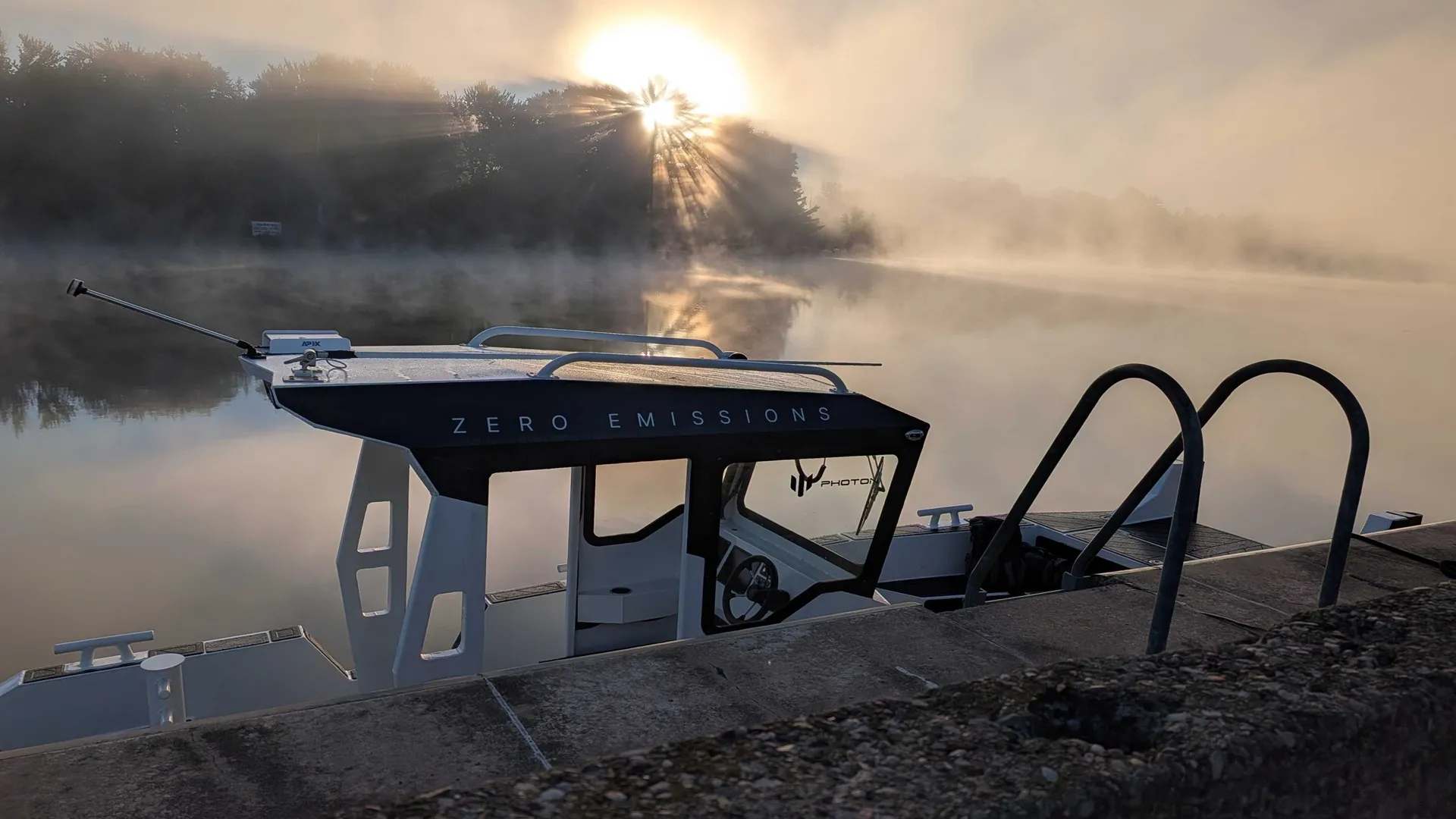
US marine electric propulsion developer Photon Marine will deploy a floating battery platform capable of high-power charging of electric boats as part of a $1 million ship electrification project in New York.
The company has received the first National Science Foundation Energy Storage Engine MegaBoost Award in New York State. The project will combine an electric workboat, a 40-kilowatt fast charger and a mobile floating energy storage system called ChargeBarge.
The focus of the demonstration is a 24-foot workboat powered by Photon Marine’s Gen-7 P300 electric propulsion system. The vessel was already operating on the New York State Canal System as part of a pilot project with the New York Power Authority and the New York State Canal Corporation.
Photon Marine now plans to demonstrate the technologies as a connected system, rather than treating electric propulsion, energy storage and charging infrastructure as separate parts. The project is expected to peak in late 2027 or early 2028.
The charging process lasts until the water
The most unusual part of the project is ChargeBarge, a 32-foot-long floating platform that carries battery energy storage and high-power chargers.
Instead of requiring permanent fast chargers at every waterfront location, the platform can transport stored energy to ships where it is needed. New York-based Derecktor Shipyards will manufacture the ChargeBarge.
The platform is designed for ship-to-ship loading, remote fleet operations and temporary events. Photon Marine also sees potential for emergency power supply in the event of grid disruptions.
A separate 40kW marine DC fast charger will provide fixed charging infrastructure for electric commercial, government and recreational vessels operating on New York’s waterways.
“The electrification of commercial shipping will only be scalable when operators can see that the technology works in the conditions they face every day,” said Marcelino J. Alvarez, co-founder and CEO of Photon Marine.
“This project gives us the opportunity to demonstrate a complete electrification ecosystem, from propulsion system to charger to mobile energy storage, building on the real-world operational experiences we have developed with NYPA.”
Boats become test benches
Commercial workboats are used for tasks such as port operations, maintenance, environmental monitoring and public safety. Electrifying them can be difficult because operators need long-lasting, high-performance propulsion as well as charging options at shore locations where suitable electrical infrastructure may not exist.
Photon Marine’s approach combines fixed charging with mobile battery storage, potentially allowing fleets to begin electrification without waiting for an extensive waterfront charging network.
The demonstration will collect data on vessel performance, battery charge and health, charge usage and duty cycles. Researchers will also study ship-to-ship energy transfer and possible interactions with the power grid.
Photon Marine plans to turn these findings into a fleet electrification guide that other commercial operators could use when evaluating similar systems.
“MegaBoost is about bridging the gap between a working technology and a product or system that customers will actually deploy at scale,” said Fernando Gómez-Baquero, director of translation for the NSF Energy Storage Engine in New York State.
The $1 million prize builds on the engine’s smaller SuperBoost commercialization program. MegaBoost is intended for technologies that have moved beyond early development and are ready for demonstrations with customers at commercially relevant scales.