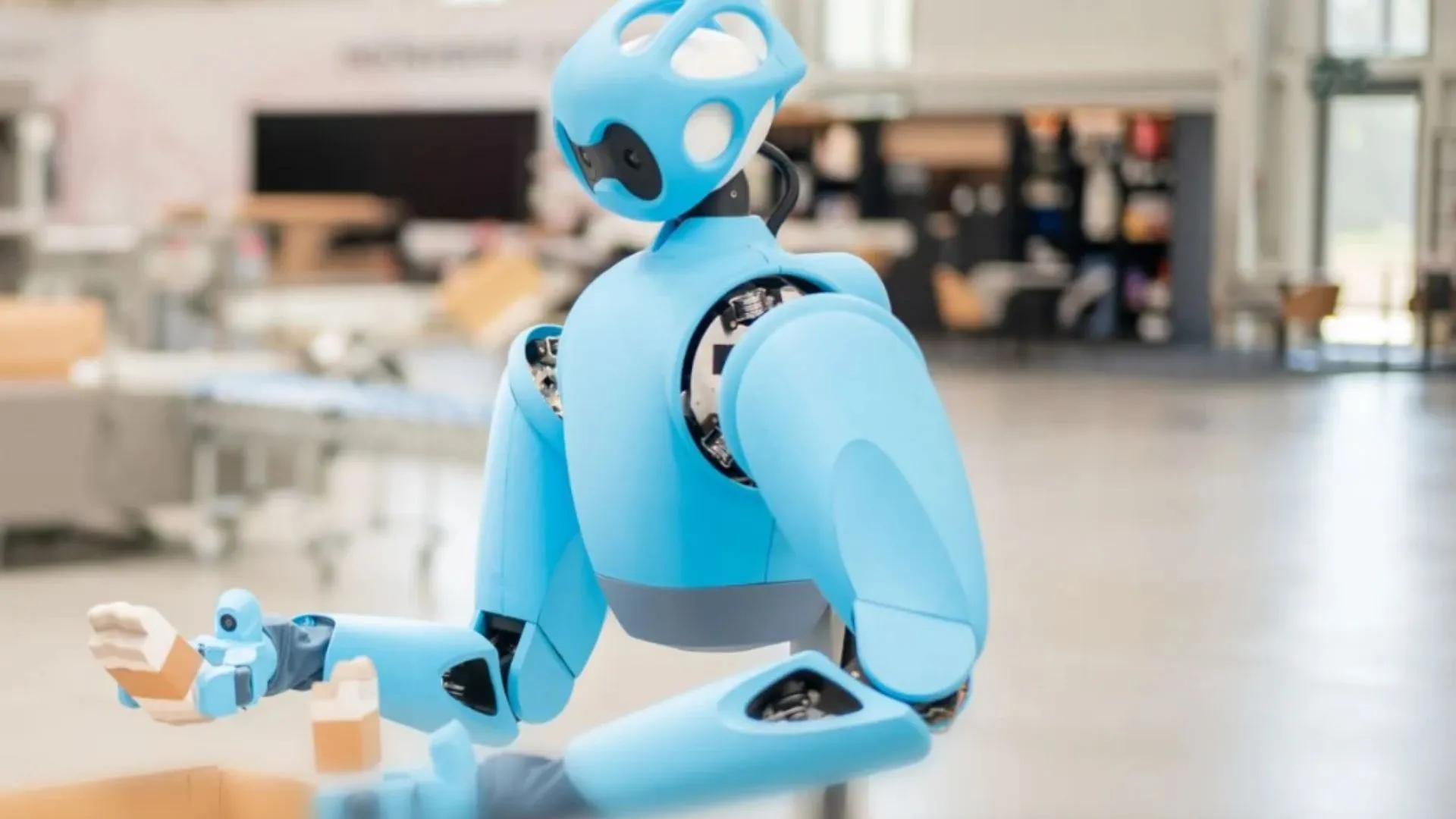
Swiss startup Embodied AI has introduced AIR, a two-armed mobile robot designed to work with factory workers without a safety cage. The company said AIR initially worked under remote supervision before learning to perform assigned tasks independently over about a month.
Embodied AI reported an average task success rate of 95 percent for paid manufacturing pilots, including assignments with companies in the consumer electronics and automotive industries.
“Security and reliability are non-negotiable requirements for physical AI to enter the real world at scale. These are the principles that guided the design of AIR,” said Francesco Stella, co-founder and CEO of Embodied AI, in a statement.
Humanoid powered by tendons
AIR is a two-armed mobile robot that can perform manufacturing tasks alongside factory workers without the need for a traditional safety cage.
Developed by a 25-person team at the Swiss Technical University EPFL, the robot combines a torso, two lightweight arms and a chassis. Unlike traditional industrial robots that rely on rigid structures and external safety barriers, AIR uses a compliant mechanical design intended to reduce the risk of injury from accidental contact.
The robot’s architecture focuses on holding heavy components in its torso while using a tendon-driven mechanism to operate its arms. Cables transfer motion from the motors to the arms, reducing the mass of the moving components. This arrangement keeps the arms light and gives way when they encounter an obstacle or person.
The design is intended to eliminate a major limitation of conventional factory automation. Industrial robot arms are often heavy and rigid, making them difficult to use in work areas that are directly shared with humans. Therefore, many installations require physical barriers or light curtains to separate machines from employees. AIR instead relies on mechanical compliance and mass distribution that keeps heavier components away from the robot’s moving limbs.
The only specific mechanical numbers released so far concern the arm. According to an investor description, the tendon-powered unit weighs about 2 kilograms (4.4 pounds) and can lift up to 5 kilograms (11 pounds). The company has not yet released AIR’s overall dimensions, weight, range, battery capacity, or maximum payload.
Another key feature is the approach to learning manufacturing tasks. AIR initially operates via teleoperation, with a human remote operator controlling the robot during its first few shifts. These operations generate training data that the company’s AI system uses to learn the assigned task. According to Embodied AI, the robot can transition to autonomous operation within about a month, allowing it to take on work that originally required human supervision.
Aimed at factory automation
The company is not starting with a completely untested software platform. AIR uses the same AI stack already deployed in a two-arm robotic cell operating on a customer’s production line. The company has used this system in paid manufacturing pilots with a consumer electronics manufacturer and an automotive and industrial technology supplier.
Embodied AI reported an average task success rate of 95 percent in these deployments. However, it did not disclose how many tasks it scored, how long the trials ran, or how it calculated the success rate. The company also said a single AIR unit can handle workloads of up to three workers per shift, depending on the application.
The robot’s initial deployment model combines human supervision with progressive automation, rather than requiring complete autonomy before entering a factory. This allows manufacturers to use the machine for productive work while their AI system collects operational data. The approach also gives the company the ability to refine task-specific capabilities using information collected in actual manufacturing environments, rather than relying solely on laboratory demonstrations.
Although AIR is described as a humanoid, he has neither legs nor a bipedal walking system. Its wheeled platform provides mobility in factory workplaces, while its torso and two arms allow it to interact with equipment and handle objects. This configuration puts it more in a class of mobile manipulation robots designed for industrial applications than a full-size, legged humanoid.
The company hasn’t announced a price or delivery schedule, but says it will start taking orders after unveiling the robot at Humanoid Europe 2026 in Munich.
