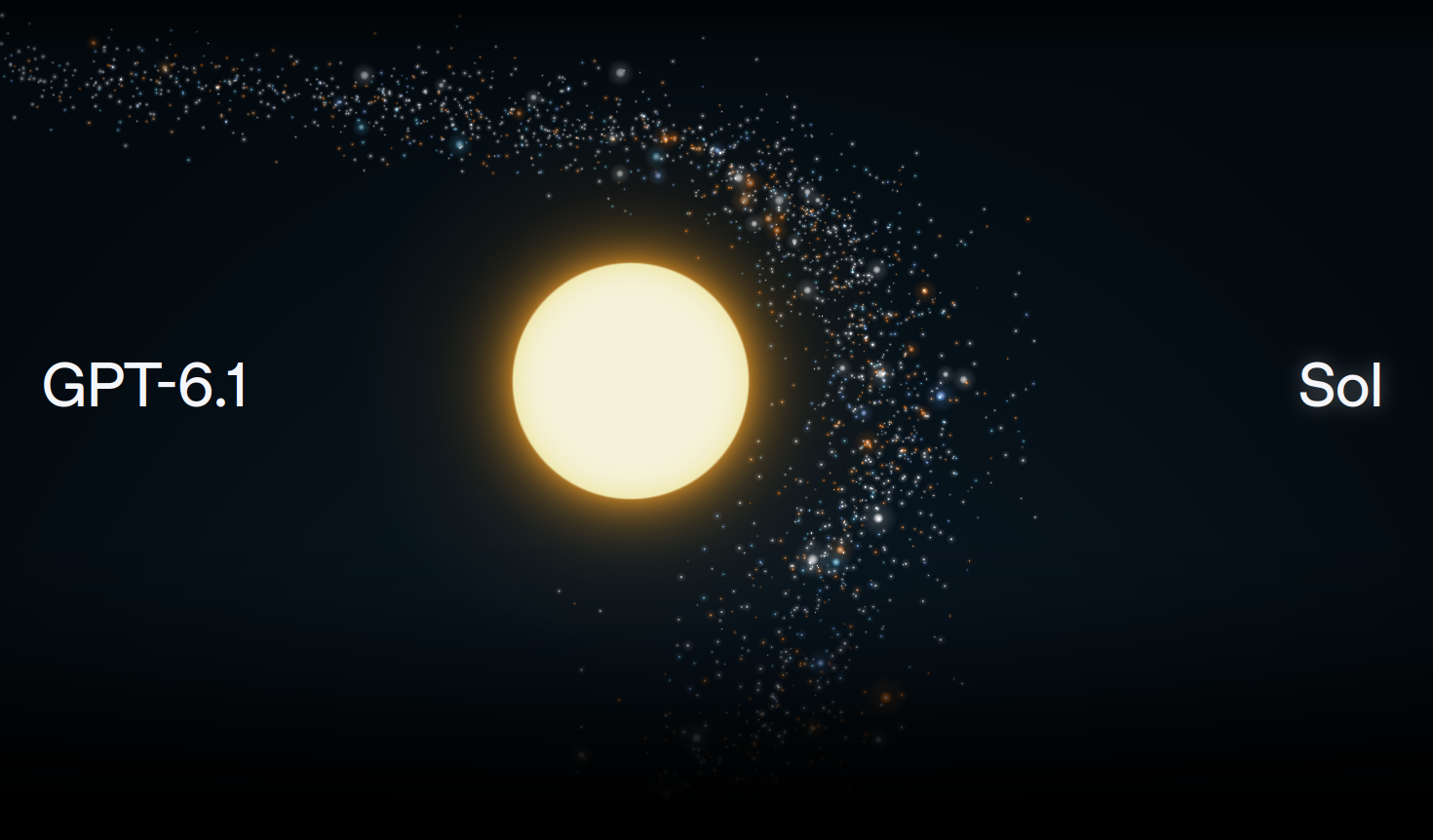
Just a day after OpenAI Group PBC said it was unwilling to release its latest model GPT-6.1 Astra due to security concerns, it has released a newer, almost equally powerful model called GPT-6.1 Sol that promises to deliver Astra-like performance at a much lower cost.
The new model, announced today at OpenAI’s DevDay event, is confusing because it appears to mock OpenAI’s model naming convention, which became even more confusing over the summer when GPT-5.6 was first introduced. At that time, three versions of this model were announced – Sol, Terra and Luna. Sol was the most powerful version, Terra was in the middle, and Luna was the cheaper, lightweight option for when cost and speed are more important than accuracy.
While this originally made sense, it became even more confusing when the company moved on to GPT-6 and nicknamed it “Astra.” It said Astra was the most powerful version of the model and soon released two more, Luna and Sol. Terra had somehow been abandoned and Sol had been relegated to the mid-tier.
Now comes GPT-6.1 Sol, and the company claims that it is more or less comparable to GPT-6.0 Astra in terms of performance, especially in coding and intelligence-based tasks, with the difference being that it is much cheaper.
OpenAI presented a series of benchmark results to drive this point home. For example, GPT-6.1 Sol achieved the same score as GPT-6 Astra on DeepSWE 1.1, a benchmark for evaluating the software engineering performance of models, but cost about a fifth as many tokens per task. On the AutomationBench benchmark, which measures the performance of agents in multi-stage business processes, GPT-6.1 Sol fell just short of GPT-6 Astra’s performance, but outperformed Anthropic PBC’s Claude Opus 5.5, costing around a third in token consumption.
OpenAI also tested GPT-6.1 Sol in computing usage tasks, where it beat GPT-6 Sol by more than 7% and fell just short of GPT-6.1 Astra. The company said it also experienced fewer factual errors compared to GPT-6 Sol. The cost savings of using GPT-6.1 Sol instead of GPT-6.0 Astra are significant, OpenAI said. The new model is expected to cost just 10 cents per million tokens, which is about half the price of GPT-6.0 Astra. For this reason, OpenAI recommends the model for repetitive and long-duration workloads in coding, application and document work.
Nevertheless, Astra remains OpenAI’s most powerful model. The problem, however, is that the company believes it is actually so powerful that it is currently unsafe to release it publicly. That’s why OpenAI announced yesterday that it is postponing its release indefinitely, citing warnings from its own researchers and also third parties who have had the opportunity to investigate it that it has a tendency to do things without permission. GPT-6.1 Astra was scheduled to be unveiled at its DevDay event today, but the delay means the new Sol is grabbing all the headlines instead.
The company announced that it is making GPT-6.1 Sol available to all ChatGPT Work and Codex Plus, Pro, Business, Enterprise and Edu subscribers starting today. It’s not yet available for the standard ChatGPT application, but should be an option there soon.
OpenAI also used its DevDay event to introduce a new line of “always-on” artificial intelligence agents called Dots, which feature cute, emoji-like avatars and serve as 24/7 digital assistants to their users, capable of performing an expanded range of tasks.
Images: OpenAI
Support our mission to keep content open and free by interacting with theCUBE community. Join theCUBE Alumni Trust Networkwhere technology leaders connect, share information and create opportunities.
- Over 15 million viewers of theCUBE videosto spark conversations about AI, cloud, cybersecurity and more
- Over 11.4k theCUBE alumni — Connect with more than 11,400 technology and business leaders shaping the future through a unique, trusted network
Founded by tech visionaries John Furrier and Dave Vellante, SiliconANGLE Media has built a dynamic ecosystem of industry-leading digital media brands, reaching over 15 million elite tech professionals. Our new proprietary theCUBE AI Video Cloud is a game-changer in audience engagement, leveraging the theCUBEai.com neural network to help technology companies make data-driven decisions and stay at the forefront of the industry conversation.