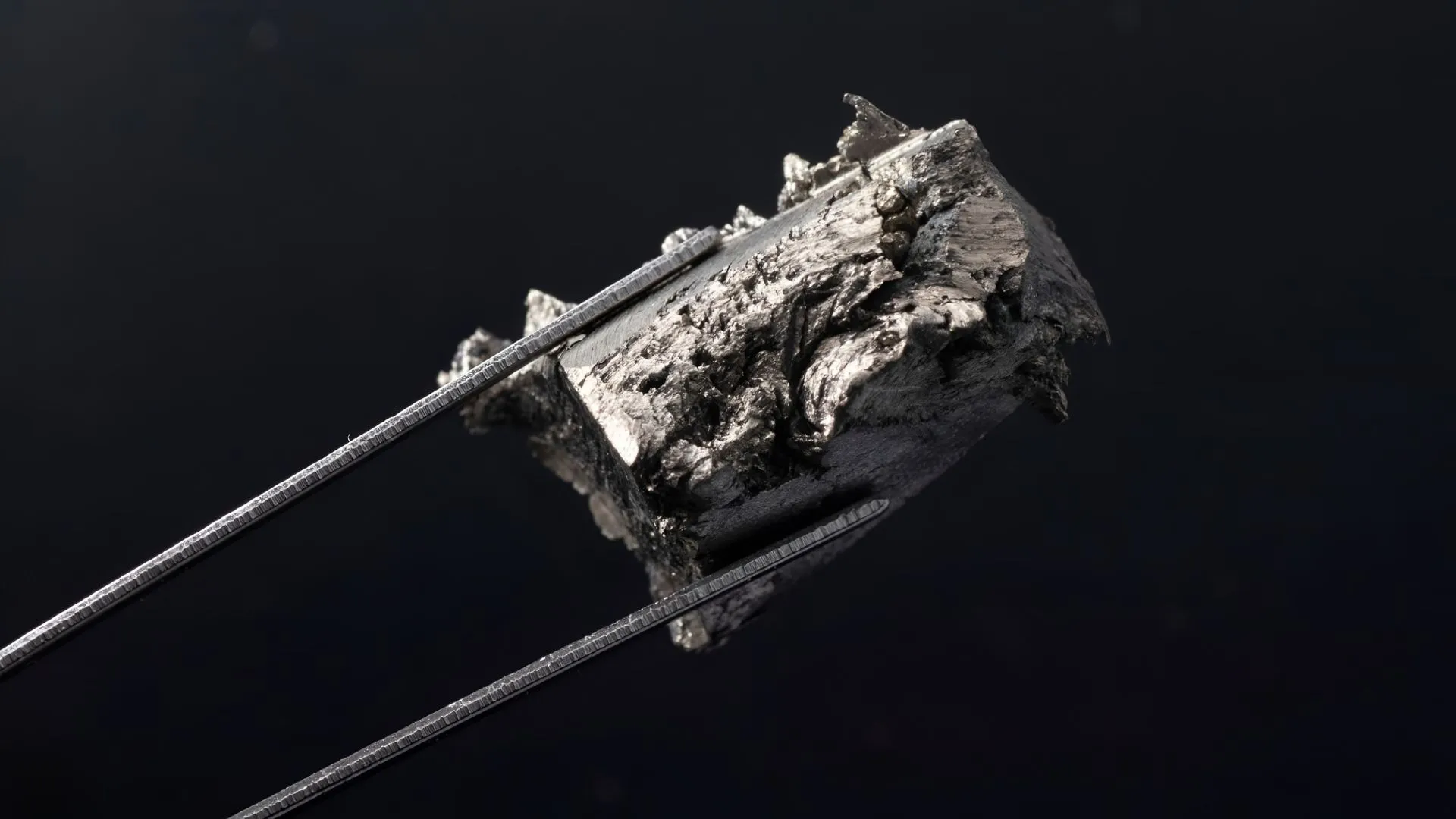
A strange magnetic state inside a compound called YbMnBi₂ could help explain one of its most unusual electrical properties.
Rice University researchers found that the material retains directional spin fluctuations even after the conventional magnetic order disappears. The finding points to a previously overlooked connection between magnetic behavior and the large anomalous Hall effect of the material.
The work challenges a previous explanation involving tilted magnetic spins. Instead, neutron experiments revealed that the manganese spins remain essentially aligned. The team now points to interactions between manganese and ytterbium as a possible cause of the unusual Hall reaction.
Spins keep their direction
Most magnetic materials lose their organized spin structure after being heated above their magnetic ordering temperature. YbMnBi₂ does something more unusual.
Its manganese spins continue to fluctuate in preferred directions after the long-range magnetic order has weakened. This behavior is similar to a liquid crystal, where molecules can move freely but still maintain their directional alignment.
Rice physicist Pengcheng Dai and his team call the state a magnetic liquid crystal. Their measurements came from neutron experiments at the High Flux Isotope Reactor and the Spallation Neutron Source at Oak Ridge National Laboratory.
These measurements also addressed a long-standing question about YbMnBi₂. Some researchers had suggested that tilted spins could create a Weyl state, which is responsible for the material’s unusual electrical response. The neutron data did not support this picture in the bulk material.
“Several proposed explanations require a tilting of the magnetic spins,” said Yaofeng Xie, a Rice graduate student and co-first author. “Our measurements showed that the spins are essentially collinear.”
Ytterbium changes the picture
The researchers then tested what happens when they remove the magnetic ytterbium component. They compared YbMnBi₂ with CaMnBi₂, which replaces ytterbium with nonmagnetic calcium. The directional spin fluctuations disappeared in the calcium-based material.
This comparison provided the team with evidence that ytterbium plays a key role in the unusual magnetic state. Further measurements revealed that some ytterbium ions carry their own magnetic moments.
These moments can respond to an applied magnetic field and interact with manganese spins. The team’s calculations suggest that this interaction could also affect the way electrons move through YbMnBi₂.
New way to the Hall effect
The Hall effect typically produces a sideways voltage when current flows through a material under a magnetic field. Magnetic materials can produce a corresponding reaction even without an external field.
YbMnBi₂ produces a particularly large anomalous Hall effect. The researchers now suggest that its unusual magnetic fluctuations could help explain why.
Their model links the ytterbium moments with the directionally fluctuating manganese spins. An applied magnetic field could organize these interactions so that moving electrons are deflected.
“The key is that the ytterbium moments and manganese spin fluctuations work together,” Dai said. Their interaction could alter electron movement and contribute to the large Hall reaction. The result offers researchers another way to study anomalous Hall effects. It also shows that magnetic disturbance does not always mean complete randomness.
In YbMnBi₂ the spins lose their long-range order but retain their directional preferences. This combination creates a magnetic state that behaves more like a liquid crystal than a traditional heated magnet.
The study is published in the journal Physical Examination X.