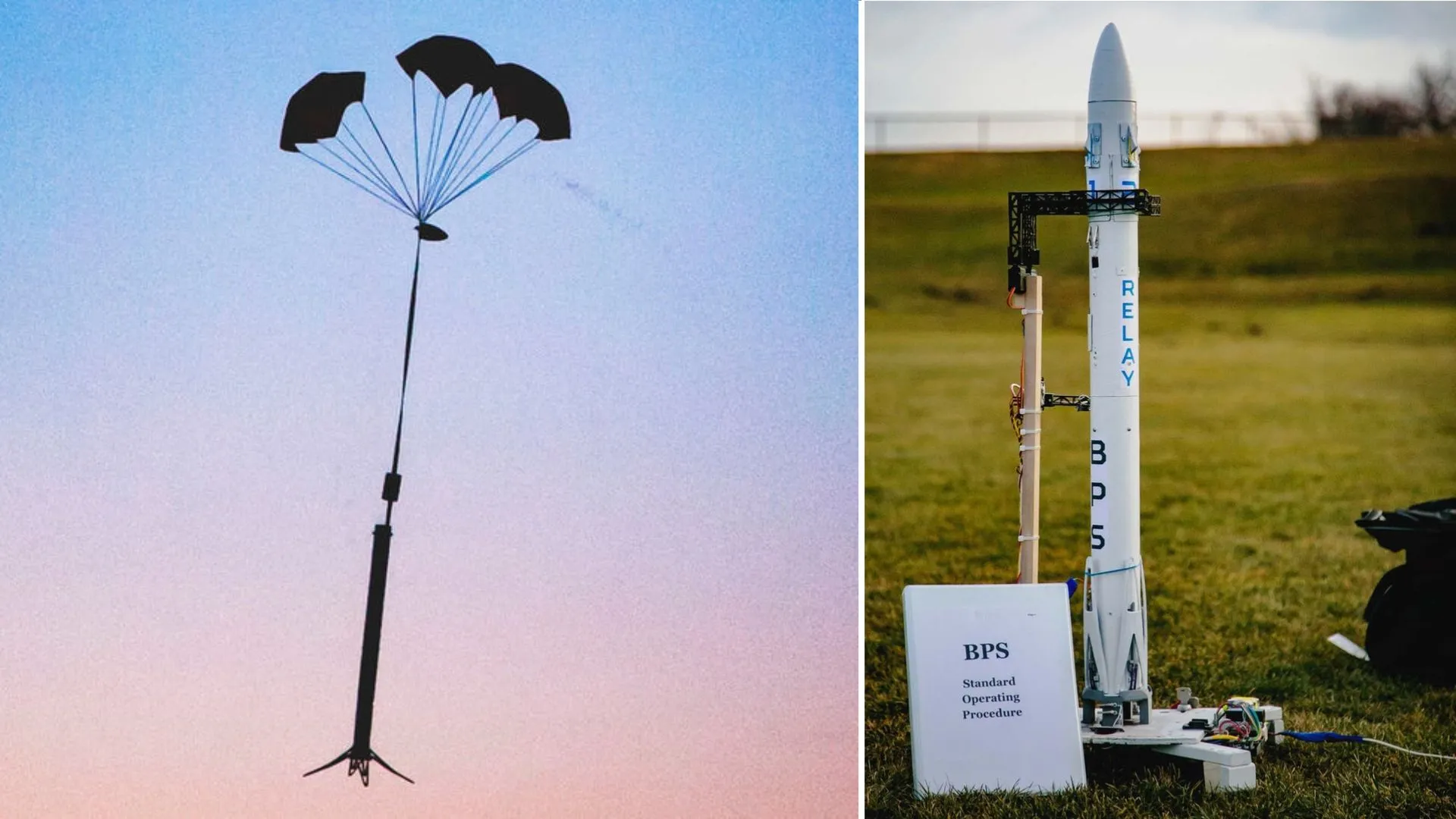
Joe Barnard, a self-taught rocket enthusiast and YouTuber, posted a video on his YouTube channel in which he flew a rocket at supersonic speeds to nearly 30,000 feet before deploying a small camera capsule near the tip to capture the parachutes opening from outside the vehicle in slow motion.
The rocket launch took place just outside Randsburg, California and the video was released on Thursday, November 5th.
According to Barnard, such views remain beyond the reach of amateur rocket experiments because of the need to balance timing, forces and recovery after the vehicle begins its journey with strong acceleration during a shaky flight.
Custom rocket design
Barnard designed the rocket and remote control system specifically to achieve the purpose at speeds of Mach 2.
Nine layers of fiberglass were used to create the upper part of the rocket. This multi-layered material increases the strength of the rocket to withstand the pressure and speed during its flight, even when there is a large opening through which the camera housing protrudes. For the ride, he also reinforced the rocket’s lower booster with a carbon fiber tube and powered it with a powerful impulse-class engine capable of delivering an average thrust of 2,300 Newtons (N). He made his own rocket fuel mixture for the launch.
In addition to the changes to the aircraft design, Barnard used a separate computer system called Fluctus to monitor the rocket’s speed, pressure and altitude and to decide on firing capsules and opening parachutes during ascent.
The camera position has been corrected
He also adjusted the camera to prepare it for the tough fight.
To ensure the lens was positioned correctly during the large-scale job, he tore the GoPro Hero 12 apart, turned it upside down, and placed it into the 3D printed housing. He added a sensor cable extension to capture the required views and updated the firmware to limit the capture rate to 240 frames per second.
Another challenge remains: How to maintain the camera’s orientation after it leaves the safe haven of the launch vehicle?
Once the capsule was ejected, it no longer had the rocket to stabilize it.
The position was secured thanks to a small battery that was triggered by a small pin at startup and powered the camera, a rotating motorcycle and a gyroscope for this task.
The spinning gyroscope prevented it from falling, allowing the camera to remain focused on the rocket and capture smooth footage of the deploying parachutes.
After recording the views, Barnard had a recovery system called Repris, which consisted of a streamer to slow the crash and a GPS tracker to locate the capsule after landing.
Incorrect crash landing prediction
The team captured the view from 30,000 feet but failed to capture the landing.
During the test, the recovery team found the upper part of the rocket and the camera housing almost 350 meters from the launch pad. The capsule remained intact and was able to successfully take aerial photographs. However, the flight system encountered a technical error when Fluctus incorrectly interpreted air pressure fluctuations as a crash landing and prematurely declared an emergency apogee, assuming that the rocket could no longer be recovered.
This signal triggered the circuits to deploy the camera housing and parachute while the rocket was still traveling at more than 700 miles per hour.
The strong aerodynamic forces shredded the parachute and tore it away from the top of the rocket, making slow-motion footage of the landing impossible.
