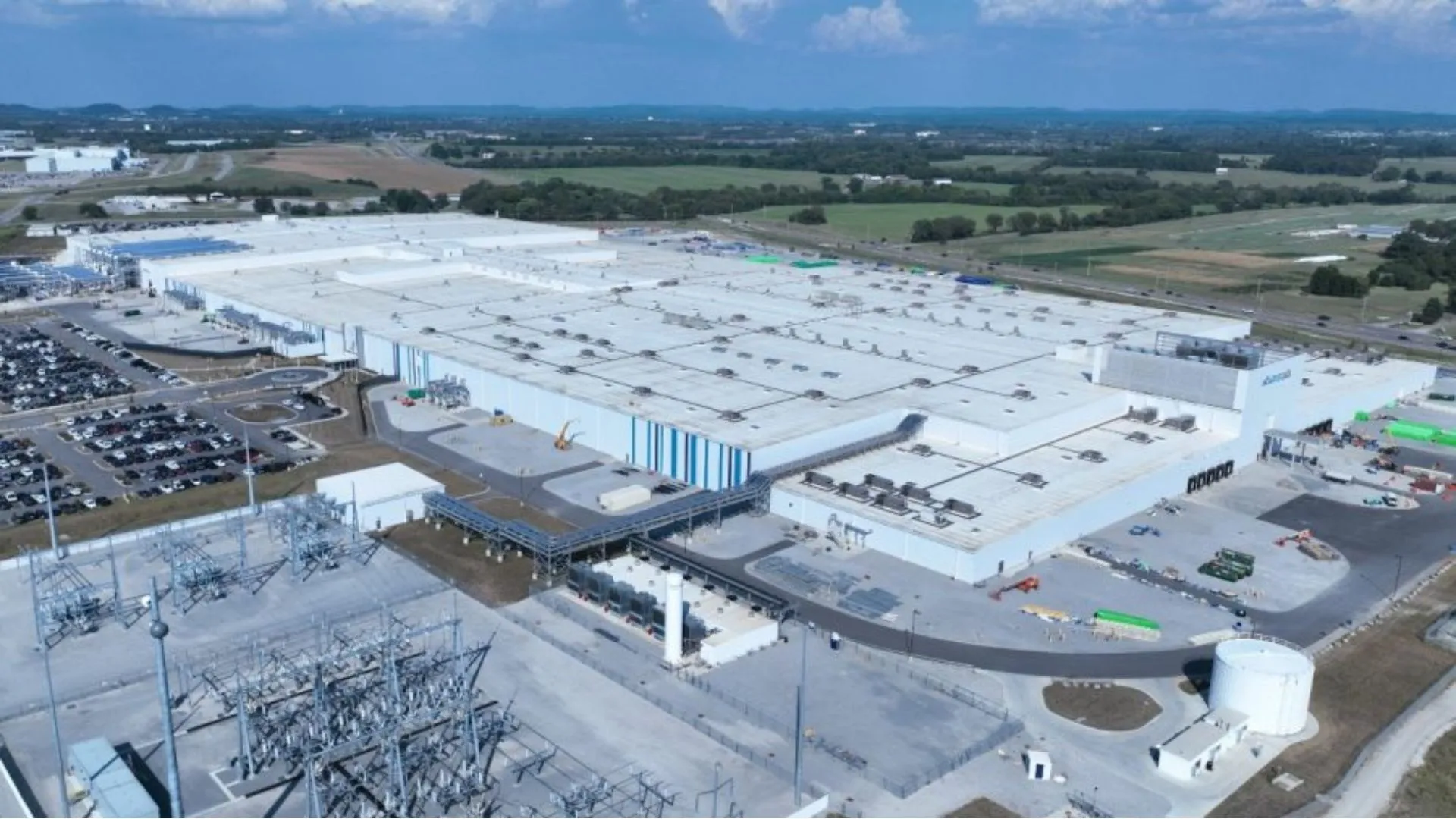
The race to build cheaper, longer-range electric cars has taken a big step forward in central Tennessee. Ultium Cells has announced that it will produce prismatic lithium-manganese-rich (LMR) battery cells at its facility near Nashville.
The company is a joint venture between General Motors and South Korea’s LG Energy Solution. Once operational, the facility is expected to be the world’s first commercial production site for this next-generation battery design.
Modernization of the Spring Hill plant will begin later this year. Engineers expect construction to be completed by 2028.
Automakers have long struggled to balance battery prices with range. Today, the global market is heavily dependent on two main chemicals: premium, high-nickel batteries that offer maximum range at high cost, and low-cost lithium iron phosphate (LFP) cells that sacrifice range to keep prices low.
Offers higher energy density
Prismatic LMR cells were designed to break this equation. The new chemistry offers 33% higher energy density than standard LFP cells, but can be manufactured at about the same price.
For General Motors, the integration of this technology represents an interim step. High-nickel batteries remain the benchmark for premium vehicles that require maximum endurance. However, LMR cells will allow entry-level and mid-range models to gain significant range without inflated sticker prices.
“High nickel batteries will continue to provide our customers with the highest range in our portfolio, while the addition of LMR enables us to leapfrog today’s cheaper chemicals and deliver lower costs with better performance,” GM said in a press release.
Company executives note that this flexibility will help GM scale vehicle production more efficiently, expand customer reach and improve profit margins.
Fixing the main bottleneck
The decision to expand production follows a major scientific hurdle that was overcome just a few weeks ago.
Although LMR chemistry has shown promise for years, it suffers from a key design flaw: gas formation. In large electric vehicle packages, trapped gases create intense internal pressure. This swelling deforms the battery’s internal structure and accelerates degradation, making large-sized cells unsafe and short-lived.
In September, researchers from LG Energy Solution and Seoul National University published a practical solution. The team discovered that gas formation is driven by volatile oxygen reactions during charging cycles.
By fine-tuning the operating voltage window, the researchers stabilized the movement of oxygen within the cell. The results were striking. In laboratory tests, optimized cells in the 40 Ah class retained 92.2% of their original energy capacity after 883 charge and discharge cycles – a durability limit suitable for automotive use.
Tailor-made packages
Beyond the chemistry itself, the Spring Hill project signals a broader shift in how modern battery factories operate.
The expansion gives Ultium Cells the ability to manufacture multiple cell chemistries and geometric form factors on the same campus. This enables the joint venture to tailor specific packages to different vehicle types, from heavy-duty pickups to compact city cars.
“Beyond expanding manufacturing capabilities, the initial launch of this new battery cell is a milestone in keeping America globally competitive as a leader in electric vehicles and battery technologies,” GM concluded.