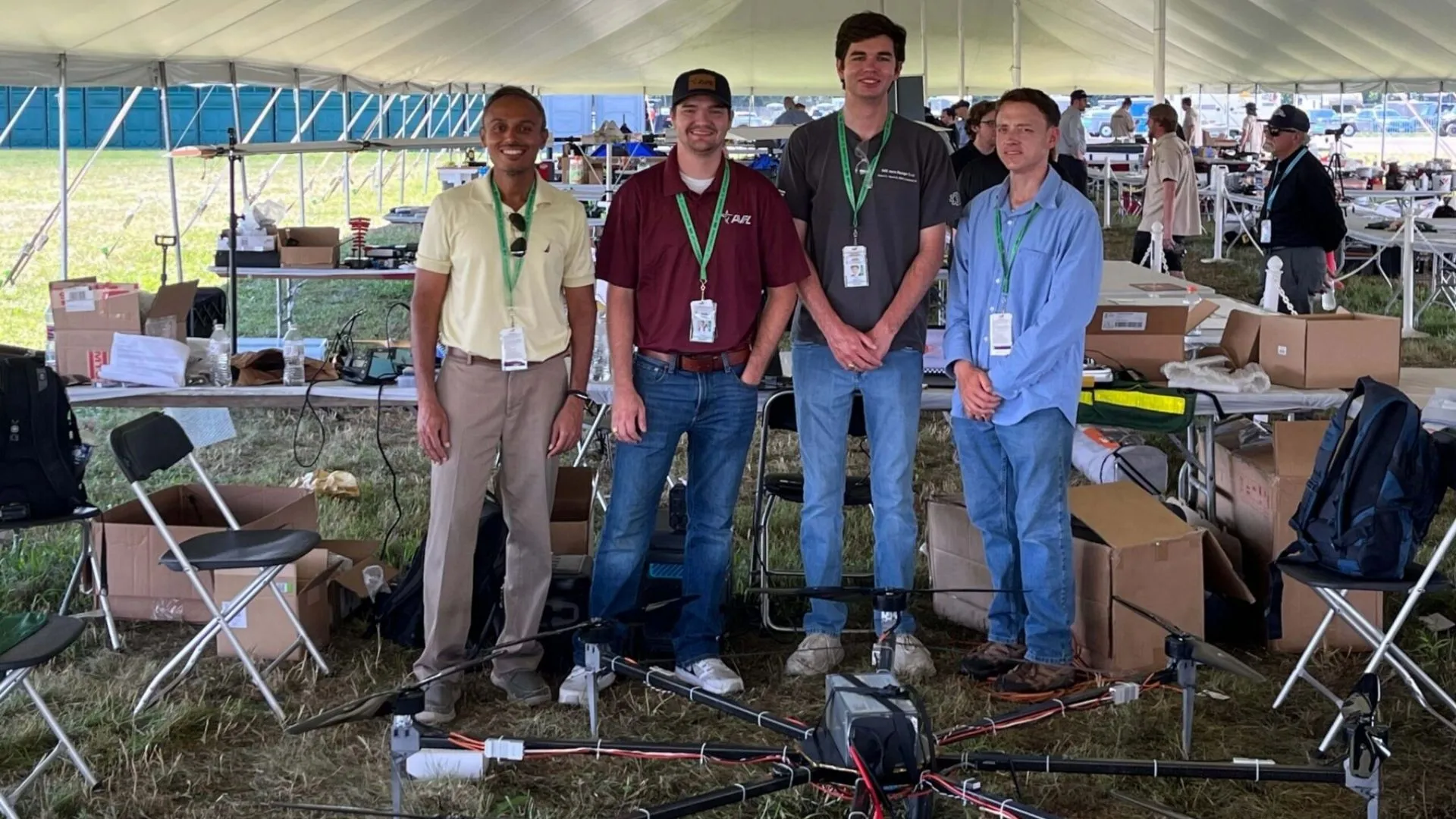
A team of aerospace engineering students from Texas A&M University have built a 50-pound drone that can carry 110 pounds over four nautical miles, demonstrating a lightweight design at the Defense Advanced Research Projects Agency’s (DARPA) first Lift Challenge.
Under the direction of Dr. Moble Benedict, professor of aerospace engineering, the Advanced Vertical Flight Laboratory team was one of just six groups of 87 to complete the competitive course Aug. 9 near the National Museum of the U.S. Air Force in Dayton, Ohio.
The challenge required teams to transport as much weight as possible over the four nautical mile route. The Texas A&M drone completed the flight in 12 minutes while carrying barbell weights more than twice its own weight.
The carbon fiber frame weighs just six pounds
The team’s key technical achievement was to reduce the structural weight of the drone while maintaining the strength required to carry a heavy payload. The final design uses a carbon fiber frame with a central battery and eight arms that support the motors and propellers. Instead of relying on traditional nuts and bolts, which can add significant weight, the students connected the structure together.
The resulting frame weighs just six pounds without a battery, although it supports a drone that can carry 110 pounds. “We had to cleverly apply the weight to make the structure as light as it is,” Benedict said. “Enabling a six-pound drone to carry 110 pounds is the key innovation we are proud of.”
The team went through multiple design iterations before arriving at the final configuration, building five prototypes in just eight months. Benedict said the process would ideally take a few years, with much of the development time spent on design work and virtual simulations before physical construction begins.
Battery power shaped the design of the drone
The team chose a battery-powered propulsion system, but its weight posed a major technical challenge. The battery made up more than half of the drone’s total weight, so students had to be mindful of mass throughout the flight.
Unlike fuel-powered aircraft, which become lighter as fuel consumption increases, the drone’s battery weighs the same weight at the beginning and end of a flight. “A battery weighs the same at the start of the flight as it does at the end,” said team member Cayden Brown. “We had to expect the same weight throughout the entire journey. A charged battery weighs exactly the same as an empty battery.”
A gas-powered system could have reduced weight, but Brown said it would have increased the complexity of a multirotor aircraft.
Possible uses include disaster relief and surveillance
The first DARPA Lift Challenge attracted approximately 480 concept submissions and 110 teams were invited to the competition. Of the 87 groups that reached the competition, only six completed the course.
The Texas A&M team hopes to further improve its prototype, which cost about $10,000 in materials. Benedict said the design could eventually support applications such as disaster relief, package delivery and surveillance.
The drone is still a prototype, and the competition demonstrated its carrying capacity as a payload rather than proving its operational readiness.
“We are very proud of this product,” said Benedict. “At this point it is still a prototype, but it has the potential to be used for many realistic missions, particularly disaster relief and surveillance.”