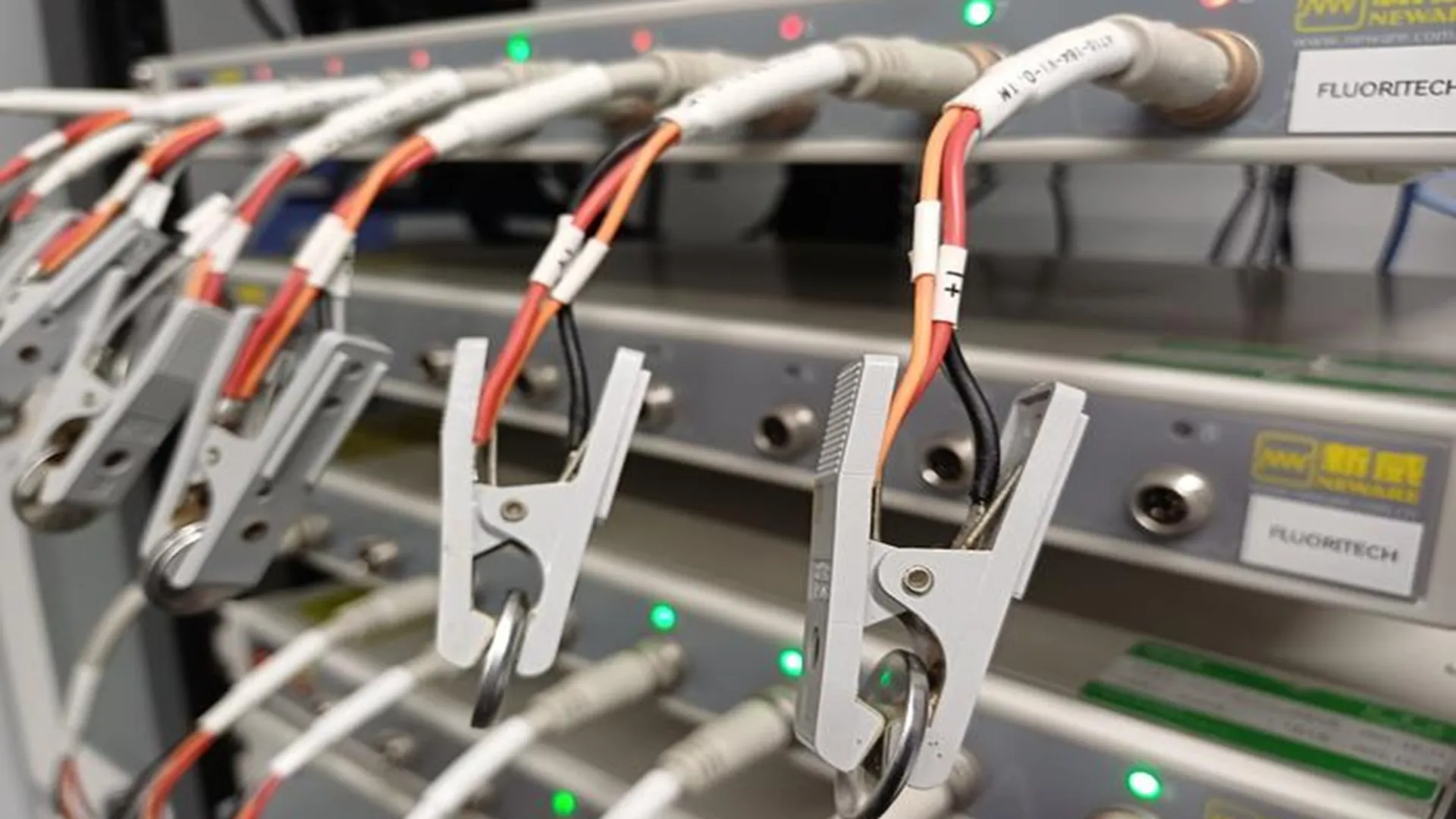
Researchers in Italy have developed a polymer membrane that allows fluoride ions to move through a battery electrolyte at room temperature, removing a major obstacle to the development of next-generation fluoride-ion batteries.
The quasi-solid gel membrane developed by a team at Politecnico di Milano acts as a fluoride exchange membrane (FEM), transporting fluoride ions between battery electrodes. The researchers say the approach could help advance alternative battery chemistry that is not lithium-based.
Fluoride-ion batteries have attracted interest because fluoride is a common element and their conversion-based chemistry offers the potential for high energy density. However, developing electrolytes that can efficiently transport fluoride ions at room temperature remains a major challenge.
The study presents a polymer electrolyte based on a perfluorosulfonamide ionomer containing tetraalkylammonium fluoride groups.
Membrane allows ion transport
To improve the movement of fluoride ions, the researchers modified the polymer membrane with a mixture of two solvents, 1,3-dioxolane (DOL) and dimethyl sulfoxide (DMSO). The solvent mixture causes the ionomer to swell and creates conditions that allow fluoride ions to move through the quasi-solid material.
Measurements using electrochemical impedance spectroscopy showed that the membrane achieved an ionic conductivity of up to 1.3 millisiemens per centimeter at room temperature.
The team also used molecular dynamics simulations to examine how the structure of the membrane and solvent composition influence fluoride ion movement. The simulations showed that DMSO plays an important role as a polar swelling agent.
The researchers then tested the electrolyte in experimental button cells with lead and lead fluoride electrodes. The cells exhibited reversible fluorination and defluorination, the processes by which fluoride ions move in and out of electrode materials during charging and discharging.
The experiments showed stable cycling for more than 50 cycles at room temperature with a current density of 0.1 °C.
Lithium-free batteries remain a long way off
The researchers describe the membrane as the first fluoride exchange membrane developed for this type of battery, drawing on the established concepts of proton and anion exchange membranes.
The university says the quasi-solid membrane is non-flammable and may provide a safety advantage for energy storage applications. However, the study’s coin cell tests do not demonstrate the fire safety or commercial performance of a full battery system.
Fluoride-ion batteries could eventually find applications in stationary energy storage, electric vehicles and aviation. Their theoretical energy density could also exceed that of conventional lithium-ion technologies.
The research team reported a potential energy density of about 600 watt-hours per kilogram, compared to about 150-250 Wh/kg for standard lithium-ion batteries. Such numbers represent the potential rather than the performance of the experimental cells.
The work was coordinated by Maurizio Sansotera, the electrochemical characterization was led by Luca Magagnin and the molecular dynamics research was contributed by Giuseppina Raffaini. Federico Maria Scesa was the lead author of the article.
Despite advances, fluoride-ion batteries remain an emerging technology. Researchers still need to improve electrode materials, battery stability, cycle life and overall performance before the chemistry can compete with established lithium-ion systems.
The new membrane offers a possible way to transport fluoride ions at room temperature, bringing researchers one step closer to practical batteries that use a different charge carrier.
The story appears in the diary Energy storage materials.
